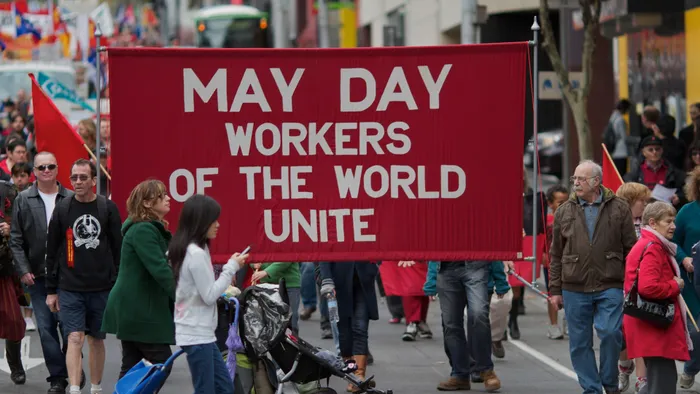
Workers’ Day, observed annually on May 1, commemorates historical labor struggles for improved working conditions and the enduring fight for workers' rights across the globe. The international observance has its roots in the United States, tracing back to key protests in 1886 when thousands of workers initiated strikes, demanding shorter working hours and safer environments. This significant day serves as a powerful reminder of the sacrifices made by countless individuals in the pursuit of fair labor practices and dignified work. In South Africa, Workers’ Day achieved official recognition as a public holiday in 1995, a landmark decision signifying the nation's profound acknowledgement of the labor movement's historical significance and its ongoing relevance in shaping a more equitable society.
Global Roots of May Day
Workers’ Day originated from the global labour movement of the late 19th century, a period characterized by widespread industrialization and often exploitative labor practices. Labour movements across Europe, Latin America, and parts of Asia subsequently adopted May 1 as a dedicated day to recognize workers’ rights and advocate for improved conditions. During this period, it was common for labourers to work between 10 and 16 hours a day under harsh and often unsafe conditions, with little to no legal protection or recourse. The demand for an eight-hour working day became a central rallying cry for workers seeking a better balance between their professional and personal lives, encapsulated in the popular slogan, "Eight hours for work, eight hours for rest, and eight hours for what we will."
The demonstrations and calls for change culminated in the Haymarket Affair in Chicago in 1886. This series of events began with a general strike on May 1, involving hundreds of thousands of workers across the United States, all demanding an eight-hour workday. On May 4, during a rally held in Haymarket Square as part of these ongoing protests, violence tragically erupted. An unknown individual threw a bomb at the police, who then opened fire on the crowd. The incident resulted in the deaths of several police officers and civilians, and numerous injuries. The Haymarket Affair, despite its tragic outcome, became a significant and symbolic moment in the struggle for workers' rights globally, galvanizing labor activists and movements worldwide.
Following these events and persistent advocacy by international labor organizations, many countries eventually recognized May 1 as a public holiday to commemorate the sacrifices and achievements of the labour movement. This global recognition shows the universal nature of the struggle for fair labor standards and the interconnectedness of workers' movements across borders. Despite its origins stemming from events in the United States, that country does not officially celebrate May Day as Labour Day. Instead, the United States marks its Labour Day in September, a tradition that began in 1882 and was officially recognized by the federal government in 1894.
South Africa's Labour Movement
Workers in South Africa historically fought for improved working conditions, including fundamental demands such as shorter working hours, specifically the implementation of an eight-hour working day, and significantly safer environments. The struggle for these basic rights was often intertwined with the broader fight against racial discrimination and political oppression under the apartheid regime. Trade unions emerged as a central and indispensable force in South Africa, playing a significant role not only in advocating for workers' economic interests but also in directly opposing the apartheid regime. Their activism was not limited to workplace issues but extended deeply into the broader political struggle for equality and democracy, recognizing that true worker liberation could only be achieved within a free and democratic society.
Labour activism intensified significantly in South Africa during the 1970s and 1980s, a period marked by growing resistance to apartheid policies and a fervent desire for greater worker representation and rights. This era witnessed a surge in strikes, boycotts, and protests, particularly within key industrial sectors like mining, manufacturing, and transportation, which were key to the apartheid economy. Workers, often facing severe repression from the state, organized courageously to demand better wages, improved conditions, and an end to discriminatory labor laws. A key moment in this escalating struggle was the formation of the Congress of South African Trade Unions (COSATU) in 1985. COSATU's establishment marked a significant turning point, as it effectively consolidated workers' power by uniting various labor movements under one powerful umbrella. This consolidation not only strengthened the collective bargaining position of workers but also explicitly aligned the labor movement with the broader anti-apartheid struggle, providing a powerful and organized front against the government. The union federation quickly became a key player in the national liberation movement, advocating vociferously for both workers' rights and political freedom, and playing a key role in the eventual dismantling of apartheid.
The recognition of Workers' Day as a public holiday in South Africa in 1995, just a year after the nation's first democratic elections, was a testament to the profound impact of the labor movement on the country's journey to democracy. It honored the countless individuals who fought and sacrificed for a more just and equitable society, and enshrined the principles of workers' rights within the new democratic framework.
Persistent Employment Struggles
Despite the historical victories and the establishment of Workers' Day, South Africa's employment landscape continues to present significant challenges, reflecting the complex socio-economic realities of the post-apartheid era. The official unemployment rate was recorded at 31.4% in the fourth quarter of 2025, a figure that shows the persistent difficulties many South Africans face in securing stable employment. This figure, however, marked the lowest reading since the third quarter of 2020, offering a glimmer of relative improvement amidst ongoing economic pressures. During the last quarter of 2025, just over 17 million people were employed across the country, indicating a substantial workforce but also noting the large proportion of the population still seeking work.
Youth unemployment remains a critical concern, posing a significant threat to the nation's future economic stability and social cohesion. Approximately 34.0% of individuals aged 15 to 24 in South Africa were not engaged in employment, education, or training (NEET) during the fourth quarter of 2025. This high NEET rate for young people suggests deep-seated structural issues within the labor market, including a mismatch between skills and available jobs, as well as barriers to entry for first-time job seekers. Educational attainment levels also show a clear disparity in job prospects, emphasizing the importance of education and skills development in improving employability. Individuals without a matric certificate faced an alarmingly high unemployment rate of 37.6%, indicating that a lack of foundational education significantly hinders access to formal employment. In stark contrast, graduates in South Africa experienced a significantly lower unemployment rate of 10.3% in the same period, illustrating the substantial advantage conferred by higher education in navigating the competitive job market.
While the 31.4% unemployment rate represented a relative improvement, economic projections suggest a potential reversal in the near future. Trading Economics anticipates that the unemployment rate will increase to 32.3% when the May print is released, indicating that the slight downward trend may be temporary. This anticipated rise follows a historical high point, as the unemployment figure in South Africa reached 35.3% in the third quarter of 2021, showing the volatility and persistent challenges within the nation's job market. These figures serve as a stark reminder that while Workers' Day commemorates past struggles, the fight for sustainable employment, equitable opportunities, and decent working conditions continues to be a pressing concern in contemporary South Africa. The legacy of the labor movement calls for ongoing efforts to address these deep-seated economic inequalities and secure a more prosperous future for all workers.