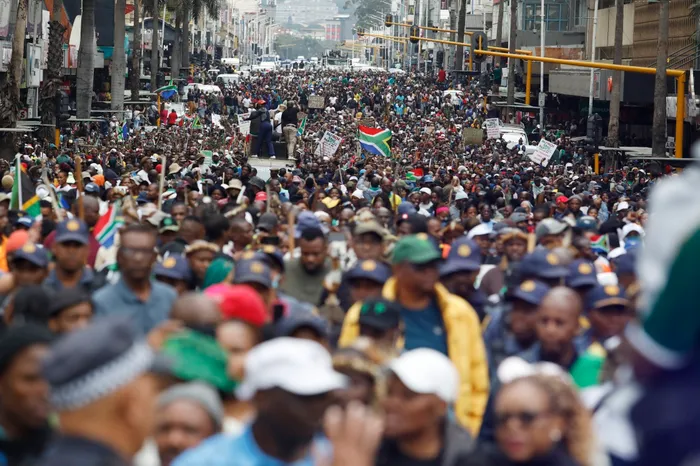
South African workers had warned against several economic policies including neoliberalism, the Growth, Employment and Redistribution (GEAR) strategy, privatisation, and premature trade liberalisation, even as the nation transitioned to democracy. These warnings were explicit and vocal, noting a deep apprehension regarding the potential economic direction. Despite the defeat of apartheid, the establishment of universal suffrage, and the entrenchment of workers' rights in law, these concerns persisted. The progressive Constitution adopted during this period enshrined many fundamental rights, yet the economic trajectory continued to be a point of contention for the working class. Former Congress of South African Trade Unions (COSATU) General Secretary Zwelinzima Vavi stated that the "greatest betrayal of democratic South Africa has been the normalisation of mass unemployment." This sentiment encapsulated the profound disappointment felt by many who had fought for a more equitable society.
Workers also expressed opposition to austerity measures, labour broking, and the commercialisation of public goods. These warnings outlined a clear apprehension regarding the potential economic direction of the newly democratic South Africa, foreseeing the detrimental impact these policies could have on livelihoods and social welfare. Vavi's assessment notes a significant divergence between the democratic promises made and the economic realities experienced by the working class, particularly concerning job security and widespread unemployment. The concerns raised by workers pointed to a future where fundamental economic issues could undermine the gains of political liberation, despite the hard-won political freedoms. Their warnings against neoliberalism, against GEAR, against privatisation, against labour broking, against premature trade liberalisation, against austerity, and specifically against the commercialisation of public goods, show a consistent and prescient critique of the economic path being forged.
The Unfulfilled Dream
The Freedom Charter, a foundational document of South Africa's liberation movement, outlined a vision that included core tenets such as popular governance, equitable distribution of the nation's wealth, land redistribution to those who cultivate it, guaranteed work and security, and equality before the law for all citizens. Specifically, the Freedom Charter promised that the people shall govern, that the people shall share in the country's wealth, that the land shall be shared among those who work it, that there shall be work and security, and that all shall be equal before the law. This charter served as a blueprint for the aspirations of a democratic South Africa, articulating a full vision for social and economic justice. The African National Congress (ANC) further articulated these principles in its Strategy and Tactics document adopted at Morogoro, which cautioned that true liberation would remain elusive unless the country's wealth was reclaimed by its entire populace. This document reinforced the idea that political freedom alone was insufficient without corresponding economic transformation.
Following the transition to democracy, the Reconstruction and Development Programme (RDP) was introduced as a framework intended to translate the ideals of the Freedom Charter into tangible government action. The RDP aimed to deliver on promises of housing, access to water and electricity, job creation, land reform, industrial development, education, healthcare, and public transport. Indeed, the RDP became the bridge between the dream of a democratic South Africa and the practical implementation by government, translating the Freedom Charter into a programme encompassing housing, water, electricity, jobs, land, industrial development, education, healthcare, and public transport. However, South Africa later adopted an austerity path, exemplified by the increase in Value Added Tax (VAT) to 15%. This measure placed a significant burden on workers and the poor, notably contrasting with the approach taken by the United States, which abandoned free-market dogma to utilize public power in rescuing its own financial system in 2008. The VAT increase to 15% stood as a stark symbol of this austerity path, placing a disproportionate burden on workers and the poor. These economic decisions ultimately shaped the post-apartheid landscape, diverging from some of the initial democratic promises and the full vision of the RDP.
The Reality of Mass Unemployment and Hunger
More than thirteen million South Africans are unemployed according to the expanded definition. This staggering figure shows the depth of the crisis facing the working class. Factories have closed in the country, and permanent work has declined significantly, contributing to the widespread joblessness. Simultaneously, labour broking, outsourcing, casualisation, and platform work have grown, often offering precarious employment with limited benefits and security. Despite these challenges, millions of South Africans gained access to housing, electricity, water, and social grants in the post-apartheid era, representing significant strides in addressing basic needs for a large segment of the population. These social gains, while key, often exist alongside persistent and growing economic insecurity.
South Africa possesses the capacity to feed its population, yet millions experience food insecurity. This situation contributes to children suffering from malnutrition and stunting, and workers increasingly find themselves unable to afford nutritious food. The country's ability to produce sufficient food stands in stark contrast to the reality of widespread hunger, noting a fundamental failure in distribution and access. The current working class in the country is diverse, encompassing precarious workers, informal workers, and domestic workers. It also includes farm workers, community health workers, unemployed graduates, and pensioners who support households, illustrating the broad spectrum of individuals affected by economic precarity and the challenges of the labour market. This diverse composition means that the crisis of unemployment and food insecurity touches nearly every segment of society.
Policy Choices and Their Consequences
South Africa's post-apartheid government made specific policy choices that have shaped its economic trajectory, including the decision to abandon a decisive industrial strategy. These choices led to premature economic liberalisation, which contributed to deindustrialisation and the toleration of labour broking and casualisation. Instead of mobilising state resources to create employment, the focus shifted towards disciplining public expenditure. These choices made include: the choice to abandon a decisive industrial strategy, to liberalise prematurely, to allow deindustrialisation, to tolerate labour broking and casualisation, and to discipline public expenditure rather than mobilise the state to create work. This set of policy decisions had profound and lasting effects on the structure of the South African economy and its labour market.
The country's transition to democracy coincided with what has been described as the high tide of neoliberalism. This global economic climate influenced the policy direction taken by the new government, pushing for market-led reforms and fiscal conservatism. The Growth, Employment and Redistribution (GEAR) strategy, introduced in 1996, marked a significant departure from earlier economic plans. According to Zwelinzima Vavi, GEAR "represented a decisive rupture with the RDP, shifting the centre of gravity from reconstruction and redistribution to fiscal discipline and market confidence." This shift meant that the government's economic priorities moved away from the initial goals of the Reconstruction and Development Programme (RDP), which had aimed to address socio-economic inequalities through a full development agenda. Instead, the focus was placed on maintaining fiscal stability and attracting market investment, often at the expense of direct social welfare and job creation initiatives, fundamentally altering the nation's developmental path.
The Erosion of Justice and Social Fabric
Justice in South Africa has become increasingly stratified by class, with the poor suffering disproportionately when detection, investigation, and prosecution processes fail. This stratification indicates a growing disparity in access to legal remedies and protection based on economic status, undermining the principle of equality before the law. Justice has increasingly become stratified by class, with the poor suffering when detection, investigation and prosecution fail, creating a system where economic standing often dictates legal outcomes. When individuals experience a loss of hope and progressive organizations are weak, reactionary forces often provide answers. This dynamic can lead to the emergence of xenophobia, Afrophobia, ethnic chauvinism, and personality cults, according to observations on the country's social fabric. The weakening of established progressive structures leaves a vacuum that such movements can exploit, offering simplistic solutions to complex problems and further fragmenting society. Reactionaries provide answers when people lose hope and progressive organisations are weak, leading to xenophobia, Afrophobia, ethnic chauvinism and personality cults, which prey on the desperation and disillusionment of the populace.
A Call for Renewal
A renewed National Democratic Revolution must focus on rebuilding the developmental state by abandoning austerity measures, reindustrialising the economy, and taxing wealth, according to proponents of such a shift. This approach also calls for stopping illicit financial flows, disciplining capital, and treating essential services such as water, electricity, health, education, and transport as public goods rather than commodities. This full renewal aims to address systemic economic issues, moving away from market fundamentalism towards a more state-led, people-centred development model. A renewed National Democratic Revolution must rebuild the developmental state, abandon austerity, reindustrialise, tax wealth, stop illicit financial flows, discipline capital, and treat water, electricity, health, education and transport as public goods, ensuring that basic necessities are universally accessible. The land question in South Africa is concurrently an urban question, encompassing challenges related to shack settlements, housing shortages, and inadequate transport infrastructure. Addressing these issues is seen as integral to improving the living conditions of the working class, acknowledging that land access and urban development are inextricably linked. One significant impact on workers' living standards in the democratic era has been the collapse of commuter rail services, which has posed a considerable challenge to daily life and economic participation. The collapse of commuter rail was one of the greatest attacks on workers' living standards in the democratic era, severely impacting their ability to access employment and essential services efficiently and affordably. This multifaceted crisis demands a holistic and determined response to fulfill the long-deferred promises of a truly democratic and equitable South Africa.