From the archive
South Africa's Record Maize Harvest Offers Short-Term Relief Amid El Niño Concerns
South Africa's record maize harvest of 17.36 million tonnes offers short-term food security, but El Niño poses future risks.
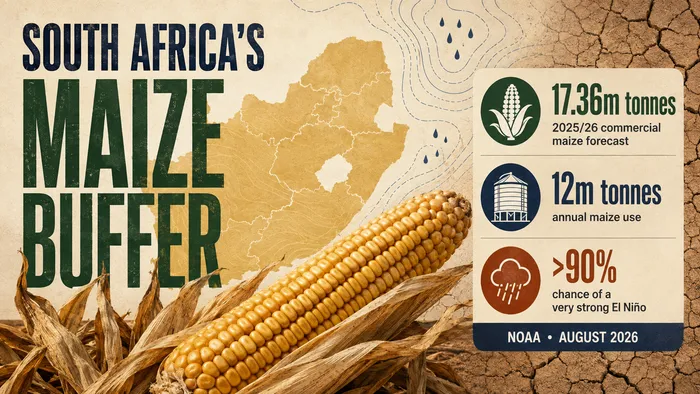
South Africa's agricultural sector is poised for a significant harvest, with a record maize crop and improved water reserves expected to safeguard against immediate food shortages, according to recent assessments. The commercial maize crop for the current season is forecast at 17.36 million tonnes. This figure represents the largest maize harvest on record for the country. The projected yield is almost 4% higher than the previous year's production, contributing to a more stable food security outlook in the short term. This strong agricultural performance, marked by South Africa’s record maize harvest and improved water reserves, should protect against immediate food shortages.
Ample Harvest Provides Buffer
The Crop Estimates Committee’s most recent forecast indicates the 2025/26 commercial summer grain and oilseed crop is projected to reach approximately 21.56 million tonnes, setting a new record. This substantial projection shows the current strength of the agricultural sector. South Africa is consequently entering the current agricultural season in a more strong position compared to the period preceding the 2015/16 drought. This improved outlook is largely due to two consecutive wet seasons, which significantly enhanced soil moisture levels, replenished groundwater reserves, and raised dam levels across the country. Additionally, rainfall persisted into May, extending beyond the typical summer rainfall season, further bolstering water availability for agricultural purposes. The two wet seasons improved soil moisture, replenished groundwater, and lifted dam levels, with rain continuing into May, beyond the usual summer rainfall season.
South Africa's annual maize consumption stands at around 12 million tonnes. The expected harvest, combined with existing carry-over stocks, is anticipated to comfortably meet domestic consumption requirements. This surplus is projected to leave approximately three million tonnes of maize available for export during the 2026/27 marketing year. Given these projections, South Africa is not expected to require any substantial maize imports throughout 2026 or 2027. The harvest and carry-over stocks should cover domestic consumption and leave about three million tonnes available for export during the 2026/27 marketing year, making it unlikely that South Africa will require any significant maize imports during 2026 or 2027. This strong position provides a key buffer against potential future challenges.
El Niño Threat Looms
Despite the current positive outlook, a strengthening El Niño climate pattern could reduce agricultural output and push food prices higher next year in South Africa. The US National Oceanic and Atmospheric Administration stated in August that El Niño was strengthening, indicating a greater than 90% chance of a very strong event during the northern hemisphere autumn and winter of 2026/27. This high probability raises significant concerns for the agricultural sector. The US National Oceanic and Atmospheric Administration said in August that El Niño was strengthening, with a greater than 90% chance of a very strong event during the northern hemisphere autumn and winter of 2026/27.
El Niño is a climate pattern characterised by unusually warm surface waters in the central and eastern tropical Pacific Ocean. This phenomenon can disrupt global weather patterns and is often associated with hotter, drier conditions in southern Africa. South Africa last experienced the phenomenon during the 2023/24 summer season, when drought and extreme heat cut maize production. This recent experience serves as a stark reminder of the potential impact of such climate events on the country's food supply. The risk of drier weather linked to El Niño will coincide with the country's summer production season, which begins in mid-October. This timing is particularly critical as it directly affects the planting and growth phases of key crops, including maize. The risk of drier weather will coincide with the summer production season, which starts in mid-October.
Expert and Policy Outlook
Food inflation could experience a mild increase in 2027, contingent on the severity of any drought conditions. Statistics South Africa reported that food and non-alcoholic beverage inflation slowed to 0.9% in July, marking its lowest level in over 16 years. During the same month, cereal prices saw a 2% year-on-year decline, while the cost of maize meal decreased by 3.1%. These figures reflect the current stability in food prices, but the potential for an El Niño-induced drought could reverse this trend. Cereal prices fell 2% year on year, while maize meal declined by 3.1% during July, contributing to the overall slowdown in food inflation. However, food inflation may nudge up mildly in 2027, depending on the severity of the drought.
The severe El Niño event of 2015/16 served as an earlier warning regarding the potential consequences of a prolonged drought, as poor harvests during that period compelled the country to rely more heavily on grain imports. The severe 2015/16 El Niño provided an earlier warning of the potential consequences of a prolonged drought, when poor harvests forced the country to rely more heavily on grain imports. This historical precedent notes the vulnerability of South Africa's agricultural sector to extreme weather patterns. Looking beyond 2027, South Africa may need to consider imports if the El Niño pattern persists for a second season. This emphasizes the importance of long-term planning and climate resilience strategies. Imports may have to be considered beyond 2027, if El Niño persists for a second season.
Approximately 82% of South Africa's commercial maize crop is produced in the Free State, North West, and Mpumalanga provinces. A significant portion of this production occurs under dryland conditions, making these regions particularly vulnerable to changes in rainfall patterns associated with El Niño. The Free State, North West, and Mpumalanga produce about 82% of South Africa’s commercial maize crop, much of it under dryland conditions. This concentration of production in rain-fed areas means that any sustained period of drought could have a disproportionately large impact on the national maize supply. The reliance on natural rainfall in these key agricultural regions shows the need for strong risk mitigation strategies to protect against the potential adverse effects of a strong El Niño event. The current record harvest provides a critical window of opportunity to prepare for these anticipated climatic challenges.