South Africa is anticipating a record 2025/26 commercial summer grain and oilseed harvest, estimated at approximately 21.56 million tonnes by the Crop Estimates Committee. This projection, specifically the Crop Estimates Committee’s latest forecast, places the record 2025/26 commercial summer grain and oilseed crop at about 21.56 million tonnes. This optimistic outlook follows two consecutive wet seasons that significantly improved soil moisture, replenished groundwater reserves, and increased dam levels across the country. Rainfall persisted into May, extending beyond the typical summer precipitation period, with rain continuing into May, beyond the usual summer rainfall season. Concurrently, cereal prices experienced a 2% year-on-year decrease, while maize meal prices declined by 3.1% during July, as reported by Statistics South Africa. This economic stability in the food sector is a notable development, especially given the broader agricultural context.
Record Harvest and Water Buffer
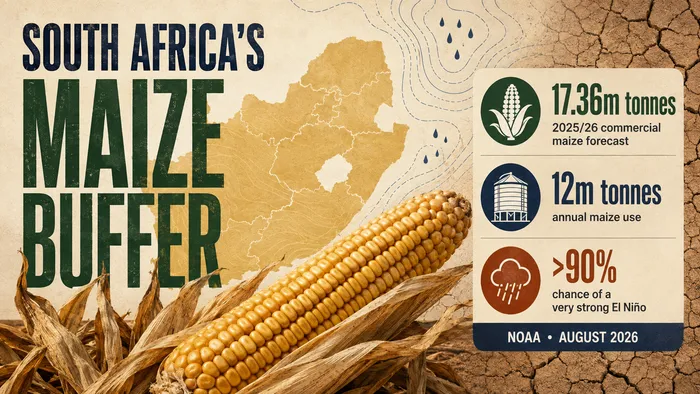
South Africa's commercial maize crop is forecast to reach 17.36 million tonnes, marking the largest on record and nearly 4% higher than the previous year's harvest. This substantial yield, specifically the commercial maize crop forecast at 17.36 million tonnes, stands as the largest on record and is almost 4% higher than last year's production. This strong harvest significantly surpasses the country's annual maize consumption, which stands at approximately 12 million tonnes. The record harvest provides a considerable buffer for South Africa's food security, offering a vital safeguard against potential future shortfalls. The current abundance means the country is well-positioned to meet its domestic needs for the foreseeable future.
However, this positive outlook is tempered by the impending threat of El Niño. El Niño is known to disrupt global weather patterns and is frequently linked to hotter, drier conditions across southern Africa. This climate pattern, characterized by unusually warm surface waters in the central and eastern tropical Pacific Ocean, can disrupt global weather patterns and is often associated with hotter, drier conditions in southern Africa. The potential impact of these conditions on future agricultural seasons remains a significant concern despite the current strong harvest, raising questions about sustainability beyond the immediate term.
El Niño's Looming Threat
The US National Oceanic and Atmospheric Administration stated in August that El Niño was strengthening, predicting a greater than 90% chance of a very strong event during the northern hemisphere autumn and winter of 2026/27. The US National Oceanic and Atmospheric Administration said in August that El Niño was strengthening, with a greater than 90% chance of a very strong event during the northern hemisphere autumn and winter of 2026/27. El Niño is a climate pattern characterized by unusually warm surface waters in the central and eastern tropical Pacific Ocean. This phenomenon typically brings hotter, drier conditions to southern Africa, posing a significant risk to future agricultural seasons. The historical precedent for such events notes the severity of the threat.
South Africa's agricultural sector is particularly vulnerable to these climatic shifts. The Free State, North West, and Mpumalanga provinces produce approximately 82% of the country’s commercial maize crop. Much of this production relies on dryland farming, making it highly susceptible to changes in rainfall patterns. The Free State, North West, and Mpumalanga produce about 82% of South Africa’s commercial maize crop, much of it under dryland conditions, which inherently increases its exposure to drought. The last severe El Niño event in 2015/16 led to widespread poor harvests across South Africa. That season forced the country to rely more heavily on grain imports to meet its domestic consumption needs, demonstrating the profound economic and food security implications. The severe 2015/16 El Niño led to poor harvests and forced the country to rely more heavily on grain imports, showing the critical importance of a domestic buffer. The current record harvest provides a key buffer, but the looming El Niño raises concerns for subsequent farming cycles, potentially impacting harvests well into the future.
Policy and Future Outlook
The risk of drier weather conditions is expected to coincide with South Africa's summer production season, which commences in mid-October. This means that the onset of the El Niño-induced conditions could directly affect the planting and early growth stages of the next major crop cycle. The risk of drier weather will coincide with the summer production season, which starts in mid-October, creating a direct conflict with agricultural timelines. This outlook follows a period of notable economic stability in the food sector. Food and non-alcoholic beverage inflation slowed to 0.9% in July, marking its lowest level in over 16 years. This period of low food inflation has provided some relief to consumers, but the potential impact of El Niño could reverse these gains.
The country's agricultural sector previously experienced an El Niño event during the 2023/24 summer season. That period was characterized by drought and extreme heat, which significantly reduced maize production. The country last experienced El Niño during the 2023/24 summer season, when drought and extreme heat cut maize production, serving as a recent reminder of the phenomenon’s disruptive power. This recent history shows the urgency of preparedness and adaptation strategies for the agricultural sector. While the current record harvest provides a substantial safety net, the cyclical nature of El Niño events necessitates long-term planning and investment in climate-resilient farming practices to ensure sustained food security for South Africa. The interplay between current abundance and future climatic threats demands careful monitoring and proactive measures from policymakers and farmers alike.