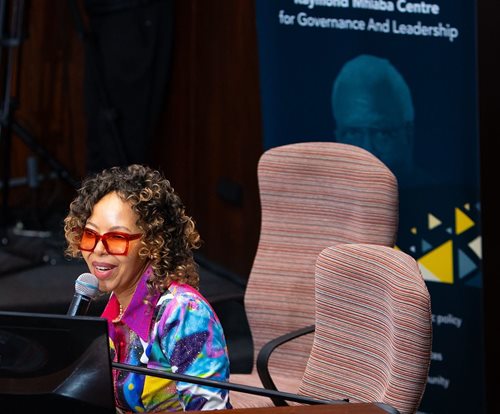
Investment executive Sonja De Bruyn stated that South Africa possesses the necessary foundations for success but is hindered by a lack of strong ethical leadership. De Bruyn delivered Nelson Mandela University’s annual Raymond Mhlaba Institutional Public Lecture in Gqeberha on August 12, under the title 'Ubuntu, Governance and Shared Prosperity: Building an Economy that Works for All'. She contended that South Africa's primary challenge is not a scarcity of opportunity, but rather the leadership required to cultivate it. This perspective formed the core of her address, noting a critical gap between the nation's inherent strengths and its current trajectory.
During her address, De Bruyn articulated her view of effective leadership, stating, "Good and strong leadership has a vision and a plan for getting from point A to point B, even if it's not in a straight line. It has resilience, it has courage and it has adaptability." She further emphasized the importance of decisive action, adding, "You don't always have perfect information, and you don't always know what the outcome is going to be. But you've got to make decisions, as best you can with the information at hand … and keep moving." De Bruyn also praised the nation's potential, remarking, "South Africa is such an interesting country, full of opportunities, and I believe we have the most amazing people." Her insights showed the belief that while the country is rich in potential, it requires a specific kind of leadership to unlock it.
Strengths and Opportunities Identified
South Africa possesses several inherent strengths, including its people, a sound financial infrastructure, abundant natural resources, and a resilient economy, according to investment executive Sonja De Bruyn. De Bruyn, co-founder and principal partner of Identity Capital Partners, a Johannesburg-based, women-led investment firm, noted the nation's human capital as one of its greatest assets. She asserted that Ubuntu is not merely a cliché, describing South Africans as inherently friendly, even towards strangers. This inherent friendliness, she suggested, forms a key part of the national character and can be leveraged for collective progress. De Bruyn's professional background includes almost three decades of experience spanning investment banking, private equity, and corporate governance, providing her with a full understanding of economic dynamics and investment landscapes. Her firm, Identity Capital Partners, is notable as a women-led entity, further distinguishing her perspective on economic development and inclusion.
De Bruyn elaborated on the nation's strong financial infrastructure, noting its sophistication and capacity to support significant economic activity. This foundational strength, she argued, provides a stable platform for investment and growth, distinguishing South Africa from many other emerging economies. The country's abundant natural resources, she added, offer substantial opportunities for various industries, from mining to agriculture, contributing significantly to its economic potential. Despite global economic fluctuations, South Africa's economy has demonstrated a notable degree of resilience, a characteristic that De Bruyn believes is often underestimated. These combined strengths, she maintained, paint a picture of a country well-equipped to achieve prosperity, given the right leadership and strategic direction. The challenge, therefore, lies not in the absence of resources, but in their effective management and utilization.
Obstacles to Growth and Prosperity
Investment executive Sonja De Bruyn addressed several realities hindering South Africa's potential, citing high unemployment, weak economic growth, and systemic failures in critical sectors such as energy, freight logistics, and municipal services. De Bruyn, co-founder and principal partner of Identity Capital Partners, contended that the nation's unemployment crisis is structural, not temporary. This structural nature, she explained, means it requires deep-seated, long-term solutions rather than superficial fixes. She attributed this ongoing challenge to a combination of factors, including persistently low growth and investment levels, which fail to generate sufficient jobs for the growing workforce.
De Bruyn also noted infrastructure failures, weak state capacity, and corruption as significant contributors to the unemployment problem. The deterioration of essential infrastructure, she argued, directly impedes business operations and investment, creating a ripple effect across the economy. She pointed to shortcomings in the education system and the transition process from school to work as exacerbating the issue. These deficiencies, she noted, leave many young people ill-prepared for the demands of the modern job market, perpetuating cycles of unemployment. The lack of alignment between educational outcomes and industry needs represents a critical barrier to economic inclusion and development. De Bruyn emphasized that strong institutions and the trustworthy custodianship of public resources are directly linked to fostering increased investment, stimulating economic growth, and creating much-needed jobs within South Africa. She argued that addressing these foundational issues is essential for unlocking the country's full economic potential and improving employment outcomes, stressing that a failure to do so will continue to stifle progress.
The Role of Ubuntu and Institutions
Ambassador Nozipho January-Bardill stated that the principle of Ubuntu must translate into institutions that effectively serve the public. January-Bardill emphasized the necessity of operational institutions for the well-being of the populace. She further elaborated that for Ubuntu to be truly meaningful in a modern state, it must manifest in tangible, functional systems that deliver services and uphold justice for all citizens, not merely remain an abstract ideal. Nelson Mandela University Vice-Chancellor Professor Sibongile Muthwa noted the annual Raymond Mhlaba Institutional Public Lecture's established reputation for drawing distinguished thought leaders. Professor Muthwa showed the lecture's consistent success in attracting prominent figures to share their insights, enriching public discourse on critical national issues. The lecture series, she noted, serves as a vital platform for engaging with complex challenges facing South Africa and proposing pathways forward.
Leadership's Visionary Path
Faculty of Humanities Executive Dean Professor Pamela Maseko acknowledged Ms. De Bruyn's significant contribution as a Black woman within South Africa's economic landscape. Professor Maseko noted De Bruyn's role as particularly impactful in this context, noting her achievements in a sector where representation for Black women has historically been limited. This recognition showed the importance of diverse leadership in shaping the nation's economic future. Separately, Ms. De Bruyn also participated in a student masterclass while in Gqeberha, offering a more intimate setting for engagement. The Raymond Mhlaba Centre for Governance and Leadership at Nelson Mandela University hosted this session, providing students with an opportunity to engage directly with the investment executive. This masterclass allowed students to benefit from De Bruyn's extensive experience and insights, fostering a new generation of informed and ethically-minded leaders. Her visit to Gqeberha, therefore, extended beyond the public lecture, creating multiple avenues for knowledge sharing and inspiration.