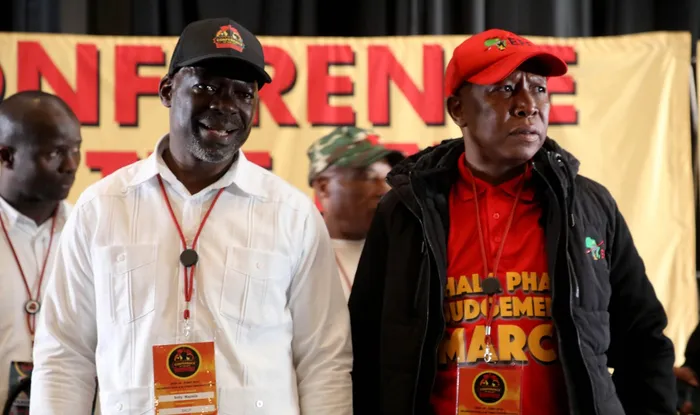
The Conference of the Left convened last month in Boksburg, South Africa, bringing together various political figures and organizations. The gathering aimed to discuss the future ideological direction for the country amidst ongoing political and economic challenges. Attendees included individuals such as Solly Mapaila, Julius Malema, Tony Yengeni, and Nco Dube. The discussions focused on potential policy shifts and collaborative strategies among left-leaning groups, reflecting a broader effort to redefine political narratives in South Africa. The event served as a platform for dialogue on national issues, including the performance of key state-owned enterprises like Eskom, Transnet, and Prasa. The Conference of the Left, held specifically in Boksburg last month, showed the urgency with which these groups view the current political and economic landscape.
The Left's Vision
The Left espouses a vision for South Africa encompassing increased public ownership, nationalisation of the Reserve Bank, and expropriation of land without compensation. Their proposals also include the abolition of outsourcing, the implementation of a public-led employment programme, and a state-led industrialisation drive. The Left advocates for a review of the Constitution, a just energy transition managed under public control, and a Universal Basic Income Grant. This grant would be funded through wealth taxes and financial regulation. The Left firmly believes that the answer to South Africa's challenges lies in these full policy reforms, emphasizing a significant shift towards state control and social welfare. Separately, the African National Congress (ANC) asserts its identity as a Left organisation, despite the distinct policy proposals emerging from the recent Conference of the Left. This assertion notes the complex and sometimes contradictory nature of political self-identification within the South African context.
The Right's Stance
The Right in South Africa maintains that the private sector should assume a leading role in the nation's economic development. This perspective advocates for deregulation, increased competition, and the application of market discipline as core tenets for growth. Adherents to this ideology also emphasize the importance of fiscal restraint in government spending and policy formulation. The Right believes that these principles are essential for fostering a dynamic economy and creating sustainable prosperity. Within this political landscape, the Democratic Alliance (DA) has consistently asserted its identity as a liberal party, advocating for policies that align with these market-oriented and fiscally conservative principles.
Beyond Ideology
South Africa requires a mixed economy, according to some analyses, featuring a capable state in critical areas, a competitive market where effective, and a strong regulatory framework where necessary. This approach also incorporates a redistributive system where just, a social compact where feasible, and a credible developmental vision. The Centre's perspective suggests that the primary solution lies in achieving greater managerial competence, arguing that efficient and effective governance is critical regardless of ideological leanings. Countries such as Singapore, China, Lula’s Brazil, Scandinavia, and Vietnam are cited as examples of nations that have implemented mixed economic models, demonstrating how different balances of state and market intervention can lead to success. These examples illustrate the potential for pragmatic approaches to economic development. Within South Africa's political discourse, the Economic Freedom Fighters (EFF) assert their radical stance, advocating for fundamental systemic change. Meanwhile, the uMkhonto weSizwe Party (MKP) maintains it represents the future, positioning itself as a new political force. Established political parties, for their part, insist they embody the nation's conscience, suggesting a continuity of values and experience.
The Path Forward
South Africa's future trajectory necessitates a balanced approach, moving beyond rigid ideological frameworks. Achieving stability and growth will require pragmatic policy choices that integrate lessons from diverse economic models, such as those seen in Singapore and Lula's Brazil. Collaborative efforts, potentially involving figures like Julius Malema and Solly Mapaila, could focus on effective governance for key state-owned enterprises like Eskom and Transnet. A truly effective path forward will likely involve a nuanced combination of public and private sector strengths, guided by competent leadership and a commitment to national development, rather than strict adherence to any single ideological blueprint.