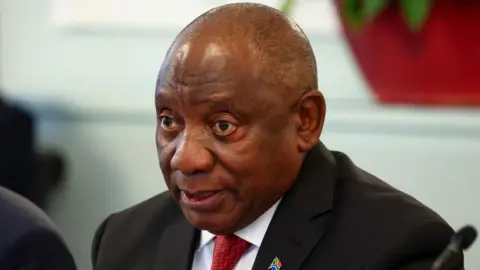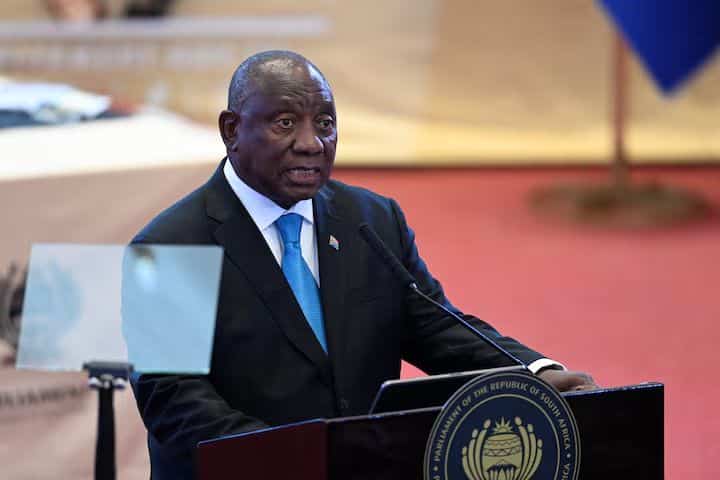
South Africa's Constitutional Court on Friday revived impeachment proceedings against President Cyril Ramaphosa, ruling that a December 2022 parliamentary vote which blocked an independent panel's report was inconsistent with the constitution. The court specifically stated that the parliamentary decision was inconsistent with the constitution and set it aside, ordering that the report, which found evidence Ramaphosa may have committed misconduct, should now be referred to an impeachment committee for a full investigation. The ruling concerns allegations that Ramaphosa potentially violated his oath of office following a 2020 theft of cash from his Phala Phala farm. Ramaphosa has consistently denied any wrongdoing, stating that the $580,000 in question were legitimate proceeds from the sale of buffaloes at his farm. An independent panel had previously found evidence of potential misconduct by the President.
Court's Landmark Ruling
The far-left Economic Freedom Fighters (EFF) initiated the legal challenge that led to the Constitutional Court's decision in 2024. The party brought the case before the country's highest court to contest the parliamentary vote. This action by the EFF sought to overturn the 2022 decision by lawmakers that had previously blocked the independent panel's report from being referred to an impeachment committee. The Constitutional Court's ruling now requires the report, which indicated potential misconduct by President Ramaphosa, to be referred to an impeachment committee for a full investigation. This judicial intervention shows the court's role in upholding constitutional principles and parliamentary oversight.
The independent panel's report, central to these proceedings, had concluded there was sufficient prima facie evidence to suggest President Ramaphosa may have violated his constitutional duties. The panel's findings were initially set aside by the parliamentary vote in December 2022, a decision now overturned by the Constitutional Court. The court's directive ensures that the allegations against the President will undergo the rigorous scrutiny of a dedicated parliamentary impeachment committee, marking a significant development in the ongoing political saga.
Prior to the Constitutional Court's intervention, two separate investigations had cleared President Ramaphosa of any wrongdoing concerning the Phala Phala incident. The South African Reserve Bank conducted one of these probes, while a public watchdog carried out the other. Both inquiries concluded without finding evidence of misconduct against the President, offering a contrasting perspective to the independent panel's assessment. These earlier findings will likely be considered alongside the independent panel's report as the impeachment committee commences its work.
The 'Farmgate' Scandal Unpacked
The scandal at the heart of the impeachment proceedings, dubbed "Farmgate" by local media, centers on events at President Cyril Ramaphosa's Phala Phala game farm in 2020. Reports indicated that the allegations involved an attempted cover-up of the theft of approximately $4 million in foreign currency, reportedly hidden in furniture. This substantial sum and its alleged concealment formed the initial basis of the controversy. President Ramaphosa, however, acknowledged a break-in occurred but stated that thieves only stole $580,000, which he said was found stashed in a couch at his Phala Phala game farm. This discrepancy in the reported amount of stolen money has been a key point of contention throughout the investigation.
Ramaphosa has also faced accusations of tax evasion, money laundering, and breaching currency laws related to the incident, according to reports. These additional allegations broaden the scope of potential misconduct beyond the initial theft. He maintains that the $580,000 in question were legitimate proceeds from the sale of buffaloes, a claim he has consistently put forward to explain the presence of such a large amount of cash on his farm. His denial of any wrongdoing underpins his defense against all accusations. The ongoing investigation by the impeachment committee will delve into these various claims and counter-claims to ascertain the full facts.
The "Farmgate" scandal has captured significant public attention in South Africa, raising questions about transparency, accountability, and the conduct of high-ranking officials. The details surrounding the theft, the amount of money involved, and the subsequent handling of the incident have fueled public debate and political discourse. The Constitutional Court's decision to revive the impeachment proceedings ensures that these questions will now be formally addressed by a parliamentary body, potentially leading to a more definitive resolution.
Political Fallout and Future Steps
The Constitutional Court's decision comes as President Cyril Ramaphosa's African National Congress (ANC) party lost its parliamentary majority in the 2024 general election. The ANC, which came to power in 1994, now governs South Africa as part of a broad coalition with other parties, according to reports. This new political landscape could significantly influence the impeachment proceedings, as the ANC no longer holds an outright majority to easily dismiss such actions. The need for consensus among coalition partners could introduce additional complexities into the impeachment process.
The Democratic Alliance (DA), the ANC's main coalition partner, has stated its intention to participate fully in the impeachment committee. This commitment from a key coalition partner signals a serious approach to the investigation and suggests that the proceedings will be thoroughly scrutinized. Reports indicated that President Ramaphosa is currently serving his last term as president. The revival of impeachment proceedings adds another layer of complexity to the political environment for the newly formed coalition government, potentially testing the stability and cooperation among its members as they navigate this high-stakes issue.
The outcome of the impeachment committee's investigation could have profound implications for President Ramaphosa's legacy and for the future of South African politics. Depending on its findings, the committee could recommend further action, including a vote on impeachment in parliament. This process will undoubtedly be closely watched by citizens and international observers alike, as it will serve as a critical test of South Africa's democratic institutions and its commitment to accountability at the highest levels of government.