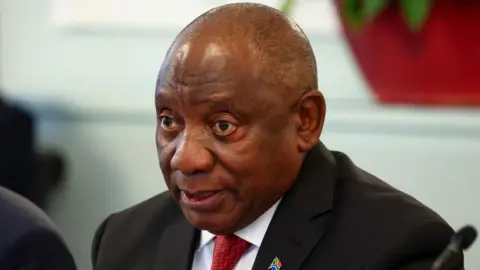
South African opposition leader Julius Malema has called for President Cyril Ramaphosa's resignation, stating that a recent court judgment could lead to new impeachment proceedings against the President. Malema, leader of the Economic Freedom Fighters (EFF), urged Ramaphosa to step down to "concentrate on this impeachment process because it has got serious implications on him as an individual." The judgment paves the way for potential fresh impeachment efforts against President Ramaphosa, as "the evidence will be before their eyes," according to Malema. He emphasized that Ramaphosa "cannot serve the two - one is going to suffer," referring to his presidency and the impending legal challenges. This strong call for resignation from a prominent opposition figure shows the significant political pressure now facing the President. Malema has consistently maintained that the President should be held accountable for the allegations surrounding the 'Farmgate' scandal, which has cast a shadow over his administration for several years.
Court Rejects Parliament's Block
The Constitutional Court determined that parliament had acted unconstitutionally by blocking efforts to impeach President Cyril Ramaphosa in 2022. This ruling stemmed from a case brought to the country's highest court in 2024 by the Economic Freedom Fighters (EFF) alongside the African Transformation Movement. The court's decision effectively reopens the possibility of impeachment proceedings against the President, challenging the previous parliamentary stance. The Constitutional Court's definitive ruling stated that parliament had violated the constitution by blocking moves to impeach President Cyril Ramaphosa, marking a significant legal and political development. This judgment follows a legal challenge initiated by Malema's Economic Freedom Fighters (EFF) and other parties, who contested the parliament’s prior decision to prevent an investigation into the President's conduct. The legal challenge, which culminated in the 2024 ruling, sought to overturn the 2022 parliamentary vote that effectively shielded President Ramaphosa from an impeachment inquiry.
When the impeachment proceedings were initially blocked in 2022, President Ramaphosa's African National Congress (ANC) held a significant majority in parliament. This parliamentary dominance allowed the ANC to prevent the advancement of impeachment motions at that time. The parliament had voted 214 to 148 against establishing an impeachment committee to investigate the allegations against President Cyril Ramaphosa, a clear indication of the ANC's then-dominant position. However, the political landscape has shifted considerably since then. Following the 2024 general election, the ANC no longer commands an outright majority and is now governing in a coalition with other parties. This change in parliamentary composition could influence future attempts to initiate impeachment proceedings, as the ANC's ability to unilaterally block such moves is diminished. The current political configuration means that any new impeachment motion would require broader cross-party support, or at least the inability of the ANC's coalition partners to block such a move, making the path to an inquiry potentially more feasible for opposition parties.
The 'Farmgate' Scandal Unpacked
The saga, dubbed 'Farmgate' by local media, began in 2020 when $580,000 had allegedly been stolen from Phala Phala, President Cyril Ramaphosa's farm in the northern Limpopo province. Investigations into the incident gained traction, and in 2022, an independent panel stated that Ramaphosa might have a case to answer regarding the theft. The panel's findings came after burglars stole $580,000 (£430,000) in cash from his rural home. The theft of funds from President Ramaphosa's Phala Phala farm led to allegations that he had not adequately accounted for the source of the cash.
The independent panel, formed two years after the theft occurred, found evidence suggesting that President Ramaphosa may have violated his oath of office concerning the incident. At the time, President Ramaphosa said the cash was from selling a buffalo. This explanation has been central to discussions surrounding the source and handling of the large sum of foreign currency. The allegations against President Ramaphosa stemmed from claims that he failed to report the theft to the police and that the origin of the large sum of foreign currency was questionable. South Africa maintains strict regulations regarding the possession of foreign currency, stipulating that it must be deposited with an authorized dealer within 30 days of acquisition. These regulations add a layer of complexity to the President's explanation regarding the cash found on his farm.
Currently, three people are on trial for the alleged theft from President Ramaphosa's farm. The legal proceedings against these individuals continue as the broader implications of the 'Farmgate' scandal for the President's office remain a significant point of contention. The initial theft and the subsequent handling of the funds have drawn considerable scrutiny from political figures and the public alike. The ongoing trial of the alleged burglars is separate from the parliamentary impeachment process but is intrinsically linked to the broader narrative of the 'Farmgate' scandal. President Ramaphosa has consistently denied any wrongdoing in connection with the incident, maintaining his innocence throughout the various stages of the investigation and public scrutiny. Despite his denials, the Constitutional Court's recent ruling ensures that the allegations against him will continue to be a focal point in South African politics.
Calls for Resignation and Next Steps
The judgment follows a legal challenge initiated by Julius Malema’s Economic Freedom Fighters (EFF) and other parties, which contested the parliament’s prior decision. In 2022, parliament had voted 214 to 148 against establishing an impeachment committee to investigate the allegations against President Cyril Ramaphosa. The theft of funds from President Ramaphosa's Phala Phala farm led to allegations that he had not adequately accounted for the source of the cash. President Ramaphosa has consistently denied any wrongdoing in connection with the incident. South Africa maintains strict regulations regarding the possession of foreign currency, requiring it to be deposited with an authorized dealer within 30 days of acquisition. The Constitutional Court’s ruling has reignited the debate over presidential accountability and the separation of powers within the South African government. As the political landscape continues to evolve, the calls for President Ramaphosa's resignation are likely to intensify, particularly from opposition parties who now see a clearer path to initiating further investigations or impeachment proceedings. The coming months will be critical in determining the trajectory of President Ramaphosa's tenure and the future of South African politics.