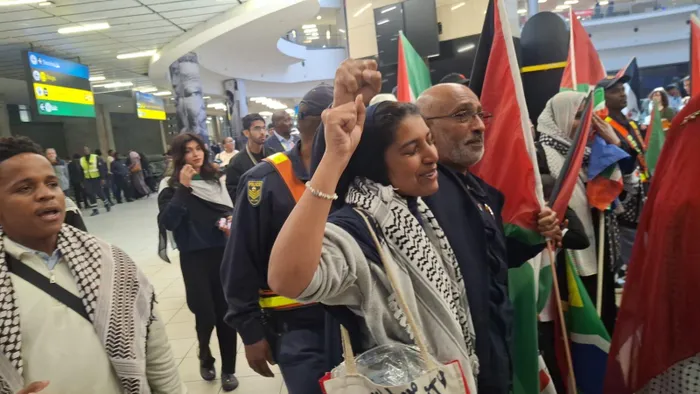
Six South African delegates from the Global Sumud Flotilla returned home to O.R. Tambo International Airport on Saturday, following their participation in the humanitarian mission to Gaza. The individuals were among those on board a vessel that was intercepted by Israeli forces as it attempted to break the blockade on the Palestinian territory. Their arrival marked the end of an ordeal that included detention by Israeli authorities. The delegates had joined the flotilla with the aim of delivering aid and drawing international attention to the humanitarian situation in Gaza. Their return to South Africa was met by supporters and family members at the airport.
Traumatic Prison Experiences
The delegates included Moghamed Faeek Afriedien, Hajar Kagiso Al Thaira Ahjum Mathee, former Ambassador Faizel Moosa, Qutb Hendricks, Ebrahim Peters, and Yusuf Rahman. Former Ambassador Moosa described his detention facility as a "notorious 400,000-square-metre concentration camp, complete with barbed wire." Moosa stated, "The system has gone way beyond being an iota of humanity. There is no humanity left." He further recounted the aggressive behavior of guards, saying, "They come like a pack of wolves, and they are violent to the core." Moosa detailed the physical abuse, explaining, "Every five minutes, they would tie your hands behind your back with handcuffs or cable ties, and push your head down to your knees while you're standing up, and they drag you."
Qutb Hendricks described how beatings began immediately upon being singled out. "When they called my name... As soon as the door closed, they pulled me into another room and the beatings started. It went on for a while," Hendricks stated. He acknowledged the intensity of the experience, adding, "I can tell you all the training that you may have thought you were prepared for didn't come into play." Moosa reflected on the broader implications of their ordeal, saying, "We have experienced what Palestinians go through every single day."
Despite the harsh conditions, the delegates expressed renewed determination. Moosa declared, "I think we are very determined to continue to fight, because you realise we are not fighting for the freedom of Palestine; we are fighting for our own freedom... We cannot live in a world that I've seen in the last six days. It's not a world for our children." Hajar Kagiso Al Thaira Ahjum Mathee emphasized the responsibility to act, stating, "If you are not doing everything that it is in your power to resist occupation... Then you are complicit with genocide. It is as simple as that." Mathee urged others to "make sure that whatever it is that you're doing, you are standing up, and that you are actioning your words." Ebrahim Peters noted his personal motivation, noting, "I've been trying with all my might to defend the people of Palestine, but this mission, I did for my children, I have three beautiful girls."
Apartheid Parallels and Calls to Action
The activists asserted they were "kidnapped" in international waters while attempting to deliver life-saving aid to Gaza. Former Ambassador Faizel Moosa drew parallels between their experience and the daily lives of Palestinians. Moosa stated, "We have experienced what Palestinians go through every single day." Sunny Morgan of the Palestinian Solidarity Alliance and Global Sumud South Africa criticized governmental inaction by stating, "We sail because governments fail." Morgan also noted the alleged treatment of delegates, noting that "the accusation of sexual violence against delegates has been verified by a number of people."
Morgan further noted that the abduction of the flotilla occurred in international waters, which he described as a violation of international law. Moosa previously recounted the aggressive behavior of guards during their detention. He stated, "They come like a pack of wolves, and they are violent to the core," describing physical abuse where "Every five minutes, they would tie your hands behind your back with handcuffs or cable ties, and push your head down to your knees while you're standing up, and they drag you." Despite the ordeal, Moosa emphasized a renewed commitment to advocacy. He declared, "I think we are very determined to continue to fight, because you realise we are not fighting for the freedom of Palestine; we are fighting for our own freedom... We cannot live in a world that I've seen in the last six days. It's not a world for our children."
Broader Context and Future Resolve
The activists recounted experiencing physical violence and emotional abuse during their detention, drawing comparisons between their conditions and a concentration camp, as well as South Africa’s apartheid history. Sunny Morgan of the Palestinian Solidarity Alliance and Global Sumud South Africa addressed allegations, stating, "the accusation of sexual violence against delegates has been verified by a number of people." Hajar Kagiso Al Thaira Ahjum Mathee contended that a failure to boycott globally recognised soft drinks or prominent international fast-food chains linked to Israel implies complicity with genocide.
Mathee emphasized the responsibility of individuals to actively resist, stating, "If you are not doing everything that it is in your power to resist occupation... Then you are complicit with genocide. It is as simple as that." Mathee urged supporters to "make sure that whatever it is that you're doing, you are standing up, and that you are actioning your words," showing the necessity of tangible action in solidarity with Palestinians.