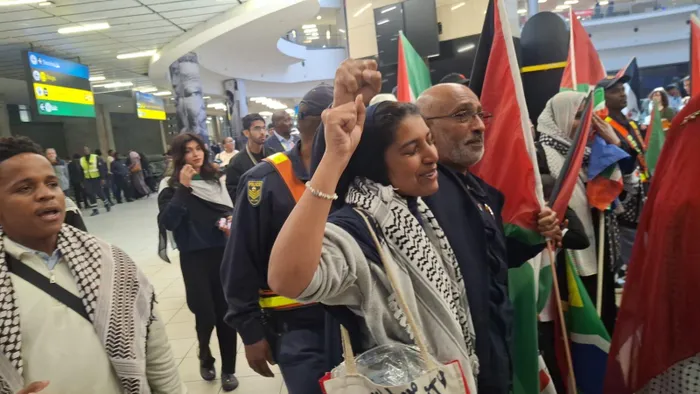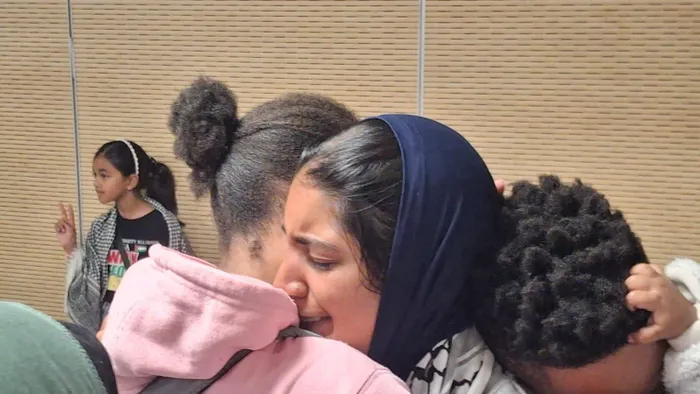
Six South African delegates, including former Ambassador Faizel Moosa, Moghamed Faeek Afriedien, Hajar Kagiso Al Thaira Ahjum Mathee, Qutb Hendricks, Ebrahim Peters, and Yusuf Rahman, returned home on Saturday, May 24, 2026, after being detained in an Israeli prison. The group was kidnapped in international waters while attempting to deliver life-saving aid to Gaza. Upon their arrival at O.R. Tambo International Airport, they were greeted by family and supporters.
Qutb Hendricks recounted his experience, stating, "When they called my name... As soon as the door closed, they pulled me into another room and the beatings started. It went on for a while." Former Ambassador Faizel Moosa described the situation, saying, "The system has gone way beyond being an iota of humanity. There is no humanity left." He added, "They come like a pack of wolves, and they are violent to the core." Moosa reflected, "We have experienced what Palestinians go through every single day," and affirmed, "I think we are very determined to continue to fight, because you realise we are not fighting for the freedom of Palestine; we are fighting for our own freedom... We cannot live in a world that I've seen in the last six days. It's not a world for our children." Hajar Kagiso Al Thaira Ahjum Mathee emphasized, "If you are not doing everything that it is in your power to resist occupation... Then you are complicit with genocide. It is as simple as that."
Accounts of Abuse and Detention
The delegates shared accounts of physical violence and emotional abuse following their detention in Israel. They likened their detention conditions to a concentration camp, drawing parallels to South Africa’s apartheid past. Former Ambassador Faizel Moosa specifically stated that the prison was a "notorious 400,000-square-metre concentration camp, complete with barbed wire." Moosa also recounted an incident where he was shot with a "rubber" bullet during his time in custody.
Qutb Hendricks described being beaten after being processed from the boats. He stated, "When they called my name... As soon as the door closed, they pulled me into another room and the beatings started. It went on for a while." All six delegates were forced to discard their phones, which left them "out of comms" and unable to contact anyone outside.
Hajar Kagiso Al Thaira Ahjum Mathee, a 22-year-old Masters student and one of the delegates, emphasized the gravity of the situation. She asserted, "If you are not doing everything that it is in your power to resist occupation... Then you are complicit with genocide. It is as simple as that." Sunny Morgan, who was involved in the mission, also stated that the "accusation of sexual violence against delegates has been verified by a number of people." These testimonies paint a stark picture of their experiences during the aid mission.
Calls for Action and Complicity
Hajar Kagiso Al Thaira Ahjum Mathee, one of the South African delegates, asserted that a failure to resist occupation renders an individual complicit with genocide. She further stated that boycotting globally recognised soft drinks or international fast-food chains linked to Israel means a person is complicit with genocide. Her remarks show an expansive view of complicity, extending beyond direct actions to include consumer choices and broader resistance efforts. The delegate's statements reflect a call for active opposition to what she describes as an occupation, linking personal and collective responsibilities to global humanitarian concerns.
Sunny Morgan, who was involved in the aid mission, issued a demand for the South African government to cease sending coal to Israel. Morgan contended that such actions contribute to complicity in genocide and urged the government to apply international conventions to prevent this. His call notes a focus on state-level economic and diplomatic actions, aiming to align South Africa's policies with international legal frameworks concerning genocide prevention. The demand for an end to coal shipments signifies a push for more stringent measures against perceived complicity.
The delegates' statements collectively indicate a broader appeal for both individual and governmental accountability. Mathee's interpretation of complicity encompasses a spectrum from direct resistance to consumer choices, while Morgan's focus is on government policy. Both perspectives show the delegates' belief that inaction or economic engagement with Israel, under current circumstances, amounts to complicity in genocide, demanding a re-evaluation of ethical and political stances by individuals and nations.
Mission's Purpose and Impact
Sunny Morgan of the Palestinian Solidarity Alliance and Global Sumud South Africa asserted that the recent aid mission achieved its primary objective by exposing what he described as Israel's "brutality and impunity." Morgan indicated that the mission aimed to highlight the challenges faced by those attempting to provide humanitarian assistance to Gaza. The group's journey and subsequent detention, according to Morgan, served to show their message on a global scale. He further explained that the delegates embarked on the mission out of a conviction that governmental bodies were not adequately addressing the humanitarian crisis. Morgan articulated this sentiment, stating, "We sail because governments fail." This statement encapsulates the motivation behind the mission, positioning it as a direct response to perceived inaction by international authorities. The mission's impact, in Morgan's view, lies not just in the attempted aid delivery but critically in drawing international attention to the conditions in the region and the treatment of those seeking to alleviate suffering. The delegates' experiences, including their detention, are presented as direct evidence supporting Morgan's claim regarding Israel's conduct.