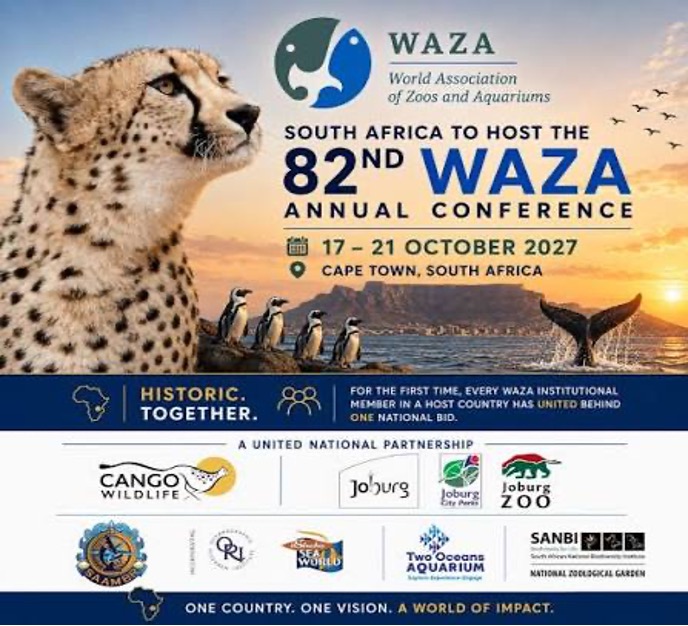
South Africa is set to host the World Association of Zoos and Aquariums (WAZA) Annual Conference in 2027, a significant event that will bring together leaders and experts from zoological and aquatic institutions worldwide. The country will welcome delegates for the international gathering, which is scheduled to take place from October 17 to October 21, 2027. This marks a significant occasion for the African continent, as it shows South Africa's growing role in global conservation efforts and its capacity to host major international scientific and environmental forums. The selection of South Africa as the host nation for this prestigious conference notes the country's commitment to biodiversity preservation and animal welfare on a global scale.
Unified National Bid
South Africa's World Association of Zoos and Aquariums (WAZA) institutional members will collectively host the 82nd WAZA Annual Conference. This marks a historic first, as it is the inaugural time in WAZA Annual Conference history that the event will be hosted through a unified national partnership involving every WAZA institutional member in the host country. Every institutional member in South Africa has united behind a single national bid for the conference, demonstrating an unprecedented level of collaboration and shared vision among the nation's zoological community. This approach consolidates the efforts of various conservation and zoological institutions across the nation, presenting a unified front for the international gathering and ensuring a full and well-coordinated hosting experience for all attendees. The unified bid reflects a strong national commitment to the WAZA mission and the advancement of best practices in zoo and aquarium management.
Key Host Institutions and Venue
The conference is scheduled to take place at the CapeTown International Convention Centre (CTICC), a world-class venue known for its capacity to host large-scale international events. Cango Wildlife and Johannesburg City Parks and Zoo are designated as the primary hosts and lead coordinators for the event, taking on the key responsibility of organizing and executing the conference's diverse program. Two Oceans Aquarium will serve as the official venue partner, providing additional support for the conference activities and offering a unique setting for certain events, leveraging its expertise in marine conservation.
Among the participating institutions is uShaka Sea World, which is operated by the South African Association for Marine Biological Research (SAAMBR). This institution brings invaluable expertise in marine biology and aquatic conservation to the conference. The National Zoological Garden of South Africa, an integral part of the South African National Biodiversity Institute (SANBI), is also listed as a participating institution, contributing its extensive knowledge in terrestrial animal management and biodiversity research. These institutions, along with others, form a strong network dedicated to the success of the 2027 WAZA Annual Conference.
Significance and Impact
The conference is expected to gather the global zoo and aquarium community in Cape Town, fostering international collaboration and the exchange of innovative ideas in conservation. This event marks a significant return to the African continent for WAZA after 28 years, noting the increasing importance of Africa's biodiversity and conservation challenges on the global stage. The five participating institutions, which include Cango Wildlife, Johannesburg City Parks and Zoo, Two Oceans Aquarium, uShaka Sea World, and the National Zoological Garden of South Africa, represent expertise spanning terrestrial and aquatic conservation, animal welfare, biodiversity research, environmental education, and public engagement. Their collective involvement notes a broad spectrum of conservation efforts within South Africa's zoological community and provides a rich environment for knowledge sharing. The conference will serve as a vital platform for discussions on global conservation strategies, sustainable practices, and the role of zoos and aquariums in educating the public about the importance of protecting wildlife and their habitats.