South Africa’s government has approached the country's Constitutional Court in a renewed effort to prevent the auction of Nelson Mandela’s personal items in the United States. This significant legal action, marking a renewed bid by the South African government, aims to halt the sale of memorabilia once belonging to the revered former president. The dispute centers on a collection of items that Guernsey's, a New York-based auction house, initially announced for sale in 2021. The government's appeal to the highest court shows the national importance attributed to these artifacts.
Disputed Heritage Items
The core of the legal dispute revolves around 29 specific objects, each holding profound historical and cultural significance. These items include Nelson Mandela's identity card, a powerful symbol of his personal history, along with several of his shirts, various writings penned by him, and notably, a key to his former prison cell on Robben Island. The South African Heritage Resources Agency (SAHRA), working in conjunction with the country's culture ministry, contends that these items are not merely personal belongings but are integral to South Africa's national heritage. They argue vehemently that the memorabilia was exported from the country without proper authorization, a process that is legally mandated for items deemed to be of national heritage value. Mandela spent 18 of his 27 years incarcerated on Robben Island, making the prison cell key a particularly poignant piece in the collection.
Legal Battles and Family Claims
The path to the current Constitutional Court intervention has been marked by several legal twists. South African courts had previously cleared the auction, a decision that initially seemed to pave the way for the sale. However, the government has since renewed its legal efforts to prevent the sale, demonstrating its unwavering commitment to repatriating these items. The auction itself was previously suspended after the South African Heritage Resources Agency (SAHRA) formally challenged the proposed sale of the items, leading to a temporary halt in proceedings. Adding another layer to the complex situation, Makaziwe, Nelson Mandela's eldest daughter, authorized the sale of the memorabilia. She stated her intention was to raise funds for a memorial garden located near her father's grave in Qunu, a project she believes honors her father's legacy.
Mandela's Legacy and Context
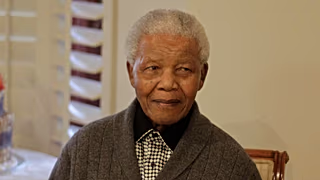
Nelson Mandela became South Africa's first democratic president in 1994, marking a key moment in the nation's history and the culmination of a lifelong struggle. He passed away in 2013 at the age of 95, leaving behind an indelible mark on the world. A file photograph captured former South African President Nelson Mandela celebrating his 94th birthday with his family in Qunu, South Africa, on Wednesday, July 18, 2012, offering a glimpse into his later years. Mandela's presidency followed decades of struggle against apartheid, a brutal system of institutionalized racial segregation and discrimination that he fought tirelessly to dismantle. His legacy as an anti-apartheid revolutionary, a Nobel Peace Prize laureate, and a global icon of peace and reconciliation continues to resonate deeply, both within South Africa and across the international community. The current legal dispute over his personal items shows the ongoing significance of his life and possessions to South Africa's national identity, noting the profound emotional and historical value placed on these artifacts by the nation he led to freedom.