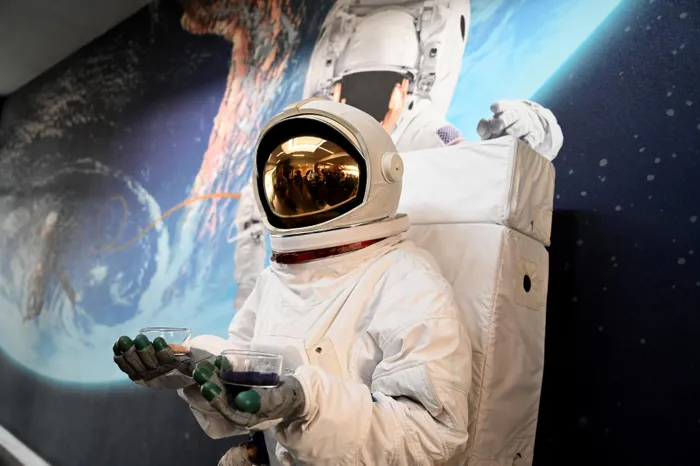
South Africa officially launched its "Rooibos in Space" programme on Thursday, an initiative that will send Rooibos seeds to the International Space Station (ISS) later this year. This pioneering programme represents a significant milestone for the nation's scientific endeavors, specifically focusing on the unique properties of the indigenous Rooibos plant. The launch event, a key moment for the project, took place at Parklands College’s Innovation Centre in Cape Town, gathering stakeholders and noting the collaborative spirit behind this ambitious venture. The programme plans for the Rooibos seeds to be launched to the ISS in October, marking a significant step for South African scientific exploration and its engagement with international space research. This mission is poised to provide invaluable insights into how terrestrial plant life responds to the extreme conditions of space, potentially opening new avenues for research in astrobotany and sustainable agriculture.
Scientific Experiment Details
The core of the "Rooibos in Space" programme revolves around a carefully designed scientific experiment. The Rooibos seeds are scheduled for exposure to microgravity and space radiation for a duration of several weeks while aboard the International Space Station (ISS). This critical phase of the experiment aims to observe the precise effects of the harsh space environment, including zero-gravity conditions and elevated radiation levels, on the biological integrity and genetic makeup of the seeds. Researchers are particularly interested in understanding any potential mutations or adaptations that might occur. Upon their return to Earth, the space-travelled seeds will be meticulously planted under controlled conditions. Researchers will cultivate these seeds alongside a set of control seeds that remained on Earth, which have been stored in identical conditions to ensure a fair comparison, allowing for a direct comparison of growth and development. This comparative study is central to understanding any potential changes induced by space conditions on the Rooibos plant's genetic material and subsequent growth patterns, offering a unique opportunity to study epigenetics and plant resilience. The findings from this experiment could have broader implications for understanding plant survival in extraterrestrial environments and for developing more strong plant varieties on Earth.
Educational and STEM Focus
Beyond its scientific objectives, the "Rooibos in Space" programme places a strong emphasis on education and fostering interest in Science, Technology, Engineering, and Mathematics (STEM) among young South Africans. Learners from seven schools in the Cederberg region will carry out the Rooibos seed experiment once the seeds return to Earth. These students will be directly involved in the planting, monitoring, and data collection phases, providing them with hands-on experience in scientific research. In parallel, a separate experiment will be conducted by students at Parklands College, a key location for the programme's launch, further broadening the educational reach. These educational initiatives aim to engage young people directly in scientific research, inspiring the next generation of scientists and engineers. The programme incorporates a creative element, with learners tasked to design the official "Rooibos in Space" mission patch. This design phase is scheduled to take place during July and August, encouraging student participation in various aspects of the space mission, from scientific inquiry to creative expression and mission branding. This holistic approach ensures that the programme serves as both a scientific endeavor and a powerful educational tool.
Expert and Official Perspectives
The South African Rooibos Council (SARC) conceptualised the entire "Rooibos in Space" initiative, aiming to explore the plant's resilience in extraterrestrial environments and highlight its unique properties on a global stage. The programme is being delivered through a collaboration with MaxIQ Space, a company specialising in space education and hardware, providing the technical expertise and logistical support necessary for such an undertaking. Further support for the ambitious project comes from the South African National Space Agency (SANSA), which plays a key role in advancing the nation's space science and technology capabilities and providing governmental backing. This multi-organisational effort shows a unified approach to scientific exploration and educational outreach within South Africa's burgeoning space sector, demonstrating a commitment to both pioneering research and public engagement. The collective expertise of these organisations ensures the scientific rigor and educational impact of the "Rooibos in Space" programme.