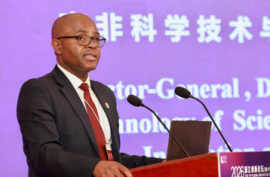
Department of Science, Technology and Innovation Director-General Mlungisi Cele addressed South Africa's challenges in research commercialisation, advocating for increased government and private sector investment during the 19th Pujiang Innovation Forum in Shanghai. The forum, which runs from September 11 to 14, heard Cele detail a "twin strategy" to overcome what he termed a "valley of death" for early-stage projects. Cele stated that commercialisation "requires a massive injection of funding," emphasizing that "The State must be prepared to invest in initiatives and projects that are high-risk. It must be fearless while also attracting private-sector investment."
The Director-General explained, "That is the twin strategy: getting more investment from government, while also attracting capital from our businesses and local companies." He urged private investment at the early, expensive stages "when projects are not yet attractive to conventional investors." Cele also noted lessons from current geopolitics, noting that "a country cannot depend on one country for technologies." He cited the United States' withdrawal of funding for HIV and other disease research as an example, stating, "We had depended on that support without planning for what would happen if it was withdrawn." This dependency impacts sovereignty, as "we want South Africa to be able to determine its own future without being subjected to external pressure," Cele added.
Bridging the Funding Gap
South Africa faces a critical juncture in transforming laboratory research into viable economic products, a transition Department of Science, Technology and Innovation Director-General Mlungisi Cele termed the “valley of death.” Bridging this commercialisation gap necessitates a shared commitment from both government and the private sector to bear the costs and risks associated with developing new technologies. Cele outlined a "twin strategy" aimed at advancing South African innovations, which involves increased government funding alongside greater private investment.
Cele stated that "The State must be prepared to invest in initiatives and projects that are high-risk. It must be fearless while also attracting private-sector investment." This dual approach is central to the strategy, with Cele explaining, "That is the twin strategy: getting more investment from government, while also attracting capital from our businesses and local companies." He emphasized the importance of private sector involvement during the nascent stages of development. "We must encourage private investment at the stage when projects are not yet attractive to conventional investors. This stage is quite expensive, and that is why we really need the private sector to work with us," Cele added.
The Director-General also noted lessons from current global dynamics, noting that "Current geopolitics has taught us that a country cannot depend on one country for technologies." He cited the impact of funding changes, stating, "Last year, the United States withdrew some of its funding, and it affected research into HIV and a range of other diseases. We had depended on that support without planning for what would happen if it was withdrawn." This dependency, Cele explained, affects national autonomy, as "When we talk about sovereignty, this is one of the challenges. We want South Africa to be able to determine its own future without being subjected to external pressure."
Lessons from China and National Sovereignty
The withdrawal of some funding from the United States of America has impacted research into HIV and other diseases, noting the vulnerabilities of relying on external support. Amid these challenges, China has reaffirmed its commitment to strengthening science, technology, and innovation cooperation with South Africa. Department of Science, Technology and Innovation Director-General Mlungisi Cele noted that South Africa could learn from China’s success in connecting scientific research, industrial development, and private-sector investment. This integrated approach is seen as a model for fostering self-reliance in technological advancement.
Cele stated that the relevant Minister is actively working to establish a coordinated approach for setting a science, technology, and innovation agenda. "The Minister is working to establish a coordinated approach to setting a science, technology and innovation agenda that will enable us to stand on our own," Cele said. This effort aims to reduce dependency and enhance the nation's capacity for independent technological development. Building the financial and commercialisation infrastructure for locally developed technologies is considered a matter of national sovereignty, ensuring South Africa can control its technological future without undue external influence.
The "Twin Strategy" for Innovation
Many projects in South Africa struggle to advance beyond initial development stages, according to Department of Science, Technology and Innovation Director-General Mlungisi Cele. These projects often secure early-stage financing but then face difficulties in obtaining the additional funding necessary for further progression. "The challenge in South Africa is that many projects are unable to progress," Director-General Mlungisi Cele stated. "Some may reach the early stages of financing, but they cannot secure the funding required to move further."
Cele emphasized that the South African State bears a specific responsibility to support innovations that are strategically important for the country. These innovations are frequently deemed too risky for conventional investors, necessitating government intervention. This support from the State is intended to bridge the funding gap for critical projects, allowing them to overcome the initial commercialization hurdles and attract subsequent private sector investment as part of the "twin strategy."