South Africa advocated for nations of the Global South to become producers and owners of emerging technologies at the Pujiang Innovation Forum in Shanghai. The call emphasizes a strategic shift towards technological sovereignty and equitable participation in global innovation. This initiative marks a significant moment as South Africa holds the distinction of being the first African nation designated as the Country of Honour at the prestigious forum. The forum provides a platform for South Africa to show its commitment to fostering technological collaboration and development among Global South countries, aiming to bridge existing digital and industrial divides. South Africa has consistently called for countries of the Global South to become producers and owners of emerging technologies, moving beyond their traditional role as mere consumers.
Urgent Call for Tech Equity
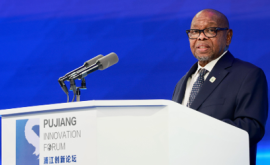
Science, Technology and Innovation Minister Professor Blade Nzimande addressed the 19th Pujiang Innovation Forum in Shanghai, China. During his address, Professor Nzimande stated, "This is also a moment of profound geopolitical and economic uncertainty, where science, technology and innovation are being increasingly weaponised by certain nation-states." He emphasized the need for the Global South to actively participate in technological development, not merely observe it.
Professor Nzimande asserted, "For this reason, we believe that the Global South cannot afford to stand on the margins of this new era. We must be co-creators of knowledge, co-designers of technology and co-owners of the industries that will define the future." South Africa advocates for the open science movement, aligning with China, Brazil, and the African Union in this endeavor. This collective effort aims to ensure equitable access and ownership of technological advancements among developing nations. South Africa champions the open science movement alongside China, Brazil, and the African Union, showing a united front for collaborative and accessible scientific progress.
Deepening South Africa-China Ties
The 19th Pujiang Innovation Forum, which convened on Saturday, September 12, 2026, noted ongoing and future technological collaboration between South Africa and China. The two nations are set to deepen their partnership across several key areas, including artificial intelligence, the establishment of joint research centres, space science and astronomy, and quantum computing. Further cooperation will encompass cybersecurity, public engagement, youth development initiatives, and the Young Scientists Exchange Programme. South Africa and China will pursue closer collaboration in artificial intelligence, joint research centres, space science and astronomy, quantum computing, cybersecurity, public engagement, youth development, and the Young Scientists Exchange Programme, indicating a full and strategic partnership.
This extensive collaboration builds upon a foundational science and technology agreement signed between South Africa and China in 1999. Cooperation between South Africa and China is governed by a science and technology agreement signed in 1999, which has provided a solid framework for their evolving partnership. Since its inception, the cooperation has significantly broadened, now incorporating diverse fields such as health, traditional medicine, astronomy, forestry, palaeontology, and energy research. The cooperation between South Africa and China has expanded into health, traditional medicine, astronomy, forestry, palaeontology, and energy research, reflecting a growing and diversified scientific alliance. The expanded focus reflects a strategic alignment aimed at fostering shared advancements and mutual development in critical scientific and technological domains.
Bridging Innovation to Market
South Africa aims to utilize the Pujiang Innovation Forum platform to advance the continent's science, technology, and innovation agenda, aligning with the African Union's Science, Technology and Innovation Strategy for Africa 2034. South Africa intends to use the platform to advance the continent’s science, technology and innovation agenda under the African Union’s Science, Technology and Innovation Strategy for Africa 2034, demonstrating a clear vision for regional development. South African universities, research councils, and innovation agencies are urged to translate the opportunities presented at the forum into concrete collaborations. These include establishing joint laboratories, developing research programmes, creating skills pipelines, and forming commercial partnerships. A key challenge South Africa faces is the progression of its inventions from prototype stages to scaled enterprises. This struggle is attributed to insufficient connection between available finance, market access, and industrial demand for these innovations. South African inventions frequently struggle to progress from prototypes to scaled enterprises due to insufficient connection between finance, markets, and industrial demand, noting a critical area for improvement within the innovation ecosystem.
Future of Global South Innovation
South Africa's participation in the World Health Organisation’s mRNA technology-transfer hub and its vaccine manufacturing ambitions illustrate a key lesson from the COVID-19 pandemic. Minister Nzimande stated that "Africa must never again stand at the back of the queue for life-saving technologies," showing the continent's resolve to achieve self-sufficiency in critical medical innovations. South Africa's vaccine manufacturing ambitions and participation in the World Health Organisation’s mRNA technology-transfer hub reflect a lesson from the COVID-19 pandemic: 'Africa must never again stand at the back of the queue for life-saving technologies,' emphasizing the importance of local production and technological independence. This initiative aligns with broader efforts to ensure equitable access and ownership of technological advancements among developing nations.
The fields identified as rapidly reshaping economies and national development include artificial intelligence (AI), quantum technologies, biotechnology, space science, advanced materials, and clean technologies. These areas represent strategic priorities for the Global South to engage in as co-creators and co-owners. Rapidly advancing fields reshaping economies and national development include artificial intelligence (AI), quantum technologies, biotechnology, space science, advanced materials, and clean technologies, all of which are key for future economic growth and societal well-being. South Africa's capabilities in mega-science infrastructure are exemplified by the MeerKAT telescope and the Square Kilometre Array, which demonstrate Africa's capacity to host, design, and operate advanced scientific facilities. South Africa's MeerKAT telescope and the Square Kilometre Array are cited as evidence that Africa can host, design, and operate mega-science infrastructure, showcasing the continent's significant scientific prowess and potential. These projects serve as a testament to the continent's potential for significant contributions to global scientific endeavors.