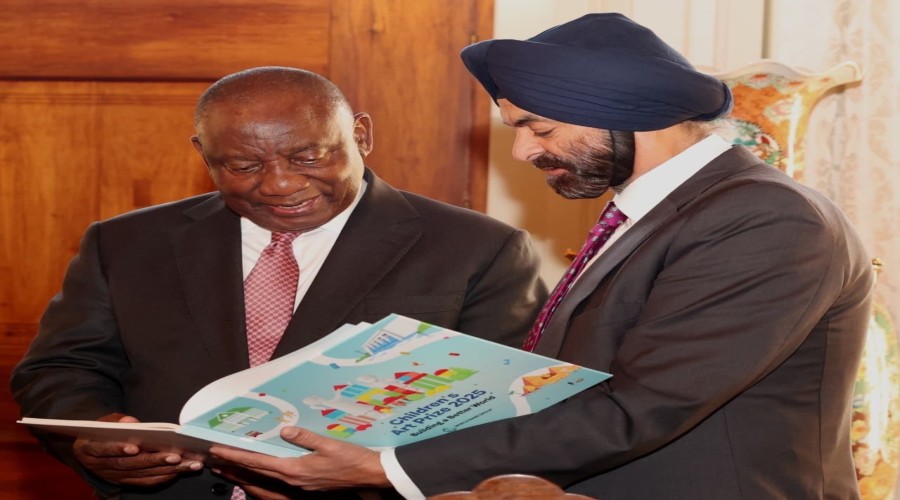
South African President Cyril Ramaphosa engaged in high-level discussions with World Bank Group President Ajay Banga on Thursday, marking a significant step towards a new development partnership. The critical meeting, focused intensely on strengthening collaborative efforts between South Africa and the global financial institution, occurred at the Mahlamba Ndlopfu official residence in Pretoria. This high-level engagement showed the mutual commitment to addressing South Africa's pressing developmental challenges and leveraging international cooperation for sustainable growth. President Ramaphosa was joined by Finance Minister Enoch Godongwana and other senior government officials during the talks, noting the full and multi-faceted nature of the discussions. The presence of key cabinet members signaled the strategic importance the South African government places on its relationship with the World Bank Group and the outcomes of these deliberations.
Shaping Future Collaboration
Discussions between South African President Cyril Ramaphosa and World Bank Group President Ajay Banga focused on advancing shared priorities critical for the nation's progress. These included modern and inclusive infrastructure development, a cornerstone for economic expansion and job creation. Human capital development, encompassing education, skills training, and healthcare, was also a central theme, recognized as vital for empowering the populace and fostering innovation. The growth of a more dynamic private sector in South Africa was emphasized, seen as essential for driving economic diversification and sustainable employment opportunities. The talks noted a strong alignment between South Africa’s economic strategy and the World Bank Group’s overarching emphasis on job-rich growth. Key focus areas identified during the discussions included achieving macroeconomic stability, implementing structural reforms to enhance competitiveness, improving state capability for more effective governance, and significantly increasing infrastructure investment across various sectors. This convergence of strategic objectives sets a strong foundation for future joint initiatives.
Long-Standing Strategic Ties
South Africa and the World Bank Group share a strategic relationship rooted in decades of cooperation, which has consistently supported the nation's economic growth and development. This enduring partnership has historically focused on various initiatives aimed at fostering sustainable progress within the country, addressing a wide array of socio-economic needs. The two entities have consistently collaborated on projects designed to address South Africa's developmental priorities, from poverty alleviation to infrastructure build-out and institutional strengthening. The ongoing engagement reflects a mutual commitment to leveraging their respective strengths for the benefit of the South African economy and its citizens. This foundational relationship underpins current discussions and future collaborative endeavors between the World Bank Group and the South African government, demonstrating a continuity of purpose and shared vision for the nation's prosperity. The long history of engagement provides a strong framework upon which to build the next phase of their strategic alliance.
Key Areas of Focus
Discussions between South Africa and the World Bank Group centered on expanding collaborative efforts under a forthcoming Country Partnership Framework. This key framework is slated to cover the period from 2027 to 2032, outlining specific future areas of cooperation and development initiatives. The focus was squarely on strengthening the partnership to address South Africa's developmental priorities over the medium to long term, ensuring sustained and impactful interventions. This strategic planning aims to meticulously align the World Bank's support with the country's national development goals and aspirations. The framework is expected to detail specific projects and programs designed to foster economic growth, improve social indicators, and enhance institutional capacity across various government sectors. It reflects a mutual commitment to sustained engagement and strategic alignment between the two entities, moving beyond ad-hoc projects to a more integrated approach. The long-term nature of the framework shows the full approach being taken to address complex development challenges in South Africa, promising a structured and coordinated effort for years to come.