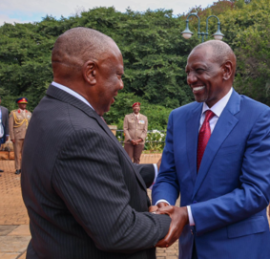
South Africa and Kenya are positioning themselves as key drivers of Africa's global agenda, following bilateral talks between President Cyril Ramaphosa and President William Ruto at the Union Buildings on Thursday, June 4, 2026. President Ruto stated that Africa is moving from the margins to the centre of international conversations, asserting the continent's active participation in global discourse.
"The point that has been made is, are we spectators in this whole unfolding scenario?... Are we making a contribution, or is our voice and our actions part of this whole equation?" President Ruto queried, emphasizing Africa's shift from a passive observer. He added, "It is our very considered view, working as people from the African continent, that for a very long time, our voice, our ideas and proposals did not find their way to fora that could influence global discourse. That has changed." The Kenyan leader noted the continent's firm stance and clear proposals on global issues, noting the growing appreciation for reforms in the international financial architecture. "Today, there is greater appreciation that there is something fundamentally wrong with the global architecture as it stands," President Ruto said.
Complementary Strengths, Shared Vision
President Cyril Ramaphosa characterized the relationship between South Africa and Kenya as complementary, not rivalrous, emphasizing a shared strategic partnership. "As President Ruto said, the two countries, Kenya and South Africa, obviously do not want to overplay our status and importance... On the African continent," Ramaphosa stated. He added, "All countries on our continent are equal, but our two countries do have an elevated voice and are able to bring about influence that is quite often able to shape things and to move things not only on our continent, but also at a global level." Ramaphosa further clarified, "We are not rivals. South Africa and Kenya never see ourselves as rivals. We are complementary, and we have our own special strategic relationship that speaks to friendship, that speaks to respect, and that speaks to equality between our two nations."
South Africa and Kenya have strengthened their cooperation through institutions such as the African Union. Ramaphosa noted this alignment, saying, "We always find that we are so well aligned on many issues, both in dealing with national issues, as well as in dealing with continental matters and global matters." Both nations have collaborated on peace initiatives in the eastern Democratic Republic of Congo, Sudan, and South Sudan. Ramaphosa noted, "Our work is based on cooperation. We cooperate well together, and we are able to come up with initiatives that are aligned, that are aimed at resolving problems on a peaceful basis, and that are aimed at advancing the interests not only of our two countries but also of other countries - sister countries on our continent."
Addressing the issue of migration, President Ramaphosa announced that South Africa would deploy envoys for diplomatic efforts. "Yes, there will be envoys. There will be people that we will [deploy], not only on the continent, but also around the world," he confirmed, adding that the goal is to get "as many key role players, countries, leaders, and countries to work together to address the challenge of migration." Ramaphosa acknowledged South Africa as a destination for people seeking opportunities, stating, "South Africa has become an oasis... For people who want to come here for a whole number of reasons."
President William Ruto called for greater mobilization of African capital for continental development projects. "What we are saying is that we need our development finance institutions (DFIs) on the continent to mobilise these resources and make them available for the development of our continent," Ruto explained. He also asserted that the African Union must be made fit for purpose to effectively serve the continent's 1.5 billion people. South African investment in Kenya's energy, transport, and infrastructure sectors exemplifies inter-African cooperation, demonstrating tangible progress in shared developmental goals.
Africa's Ascendancy on the World Stage
African leaders have successfully placed previously overlooked issues onto the global agenda, marking a shift in the continent's international engagement. This development signals a proactive approach from African nations in shaping global discourse and advocating for their priorities.
The reform of the international financial architecture stands as a key example of Africa's growing influence on the global stage. This issue, pushed by African voices, has gained significant traction in international forums, reflecting a collective effort to address systemic imbalances. This focus aims to create a more equitable global economic system that better serves the developmental needs of African countries.
In a move to strengthen financial independence and offer an alternative perspective on the continent's economic health, an African credit rating agency has been established. This agency is intended to provide more nuanced and regionally informed assessments of African economies, potentially challenging existing narratives from traditional global rating institutions. The creation of such an entity reflects Africa's determination to build its own institutions and assert its financial sovereignty.
Africa's representation at the G20 further shows its increasing participation in major global decision-making processes. The presence of African nations at this forum allows them to directly contribute to discussions on critical global economic and financial matters, ensuring that the continent's perspectives are integrated into policy formulations. This inclusion is seen as vital for addressing issues that directly impact African development and stability.
South Africa was the first African country to host the G20, an event that noted the continent's capacity to engage with and facilitate high-level international diplomacy. Hosting such a significant gathering demonstrated South Africa's organizational capabilities and its role as a prominent voice for Africa within the global community. The event also provided a platform to showcase African priorities and perspectives to world leaders. The continent's growing involvement in these high-level discussions signifies an evolving role from being recipients of global policies to active contributors and shapers of the international agenda.
Diplomatic Initiatives and Future Outlook
Presidents Cyril Ramaphosa and William Ruto asserted that Africa is increasingly shaping global debates on governance, finance, development, and peace. President Ramaphosa stated that South Africa and Kenya possess influence that can be used to advance continental priorities. "As President Ruto said, the two countries, Kenya and South Africa, obviously do not want to overplay our status and importance... On the African continent," Ramaphosa said, adding that "All countries on our continent are equal, but our two countries do have an elevated voice and are able to bring about influence that is quite often able to shape things and to move things not only on our continent, but also at a global level." He emphasized the complementary nature of their relationship, stating, "We are not rivals. South Africa and Kenya never see ourselves as rivals. We are complementary, and we have our own special strategic relationship that speaks to friendship, that speaks to respect, and that speaks to equality between our two nations." Ramaphosa further noted, "We always find that we are so well aligned on many issues, both in dealing with national issues, as well as in dealing with continental matters and global matters."
President Ruto noted Africa's shift from a passive role in global discourse, asking, "The point that has been made is, are we spectators in this whole unfolding scenario?... Are we making a contribution, or is our voice and our actions part of this whole equation?" He continued, "It is our very considered view, working as people from the African continent, that for a very long time, our voice, our ideas and proposals did not find their way to fora that could influence global discourse. That has changed." Ruto acknowledged a growing appreciation for the reform of the international financial architecture, stating, "Today, there is greater appreciation that there is something fundamentally wrong with the global architecture as it stands."
South Africa is considering diplomatic initiatives to address migration challenges. President Ramaphosa confirmed, "Yes, we are considering a number of initiatives at the diplomatic level, we are talking to a number of sister countries on our continent, with a view of getting more understanding." He added that envoys would be deployed "not only on the continent, but also around the world" to engage "as many key role players, countries, leaders, and countries to work together to address the challenge of migration."
President Ruto will participate in the G7 Summit later this month, intending to convey Africa's priorities. Ruto stated, "It is of the same spirit that I will be picking up from where President [Ramaphosa] left at the G20 and I will be taking the same message, the same priorities, and our perspectives to the G7." He showed the continent's growing global importance, asserting, "It is no longer possible to ignore a continent as big as ours, with 1.5 billion people, with the largest reserves of resources, whether energy resources, natural resources, human capital." President Ruto also believes that the African Union must be made fit for purpose to effectively serve the needs of the continent's 1.5 billion people.