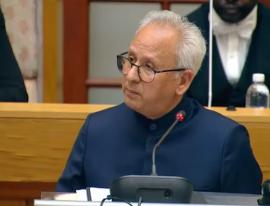
The South African Police Service (SAPS) has been allocated R127.072 billion for the 2026/27 financial year, a budget presented in Parliament on Tuesday by Acting Police Minister Firoz Cachalia. The allocation supports what officials describe as a "police reset agenda," which is positioned as a multi-year turnaround strategy rather than a short-term initiative. This full approach shows a commitment to sustained reform and operational enhancement within the police service. The budget specifically underpins a longer-term strategy designed to enhance SAPS's integrity, intelligence gathering, and investigative capabilities, aiming to build a more effective and accountable law enforcement agency. This financial commitment aims to provide sustained support for the full reform efforts within the police service in South Africa, moving beyond annual adjustments to implement foundational changes.
Acting Police Minister Firoz Cachalia formally presented the SAPS Budget Vote in Parliament on Tuesday, outlining the strategic priorities and financial commitments for the upcoming fiscal year. During his presentation, Minister Cachalia emphasized that the "police reset agenda" is explicitly described as a multi-year turnaround strategy, not merely a one-year project. This distinction notes the depth and duration of the planned reforms, signaling a long-term vision for transforming the SAPS. The budget, therefore, is not just an annual appropriation but a foundational element backing a longer-term strategy. This strategy is precisely focused on bolstering SAPS integrity, intelligence capabilities, and investigative prowess, which are identified as critical areas for improvement to restore public trust and operational effectiveness.
Strategic Investments in Core Capabilities
A primary focus of the budget is directed towards strengthening the capabilities of Crime Intelligence and the Detective Service within the South African Police Service (SAPS). This strategic emphasis aims to enhance critical investigative and intelligence-gathering functions, which are vital for dismantling criminal networks and solving complex cases. The allocation recognizes the key role these units play in combating serious and organised crime. Supporting these efforts, the Detective Critical Skills Allowance, initially introduced in October 2025, will continue to provide R1000 to eligible SAPS and Directorate for Priority Crime Investigation investigators. This allowance is designed to retain and motivate skilled personnel in these vital roles, acknowledging their specialized expertise and the demanding nature of their work. The sustained provision of this allowance is a key component in ensuring that the SAPS can attract and keep highly capable investigators and intelligence officers.
In a move to address sophisticated criminal networks, a new Organised Crime Strategy has been developed. This strategy is designed to be full, targeting the various facets of organised criminal activity across the country. The strategy is backed by substantial resource allocations, drawing funds from both the Criminal Assets Recovery Account (CARA) and the Medium-term Expenditure Framework (MTEF) budget. These financial commitments are intended to provide the necessary resources for implementing the strategy's objectives, including enhanced investigative tools, specialized training, and cross-jurisdictional cooperation. The use of CARA funds specifically shows a commitment to using proceeds of crime to fight crime, creating a circular funding mechanism for law enforcement.
Further governmental efforts are being directed towards combating the proliferation of illegal firearms. The presence of illegal firearms significantly contributes to violent crime, and the government has allocated additional resources specifically for this purpose. An allocation of R18 million has been designated for firearm licensing and compliance activities, supplementing the existing baseline budget for these operations. This additional funding shows the commitment to stricter control and enforcement regarding firearms, aiming to remove illegal weapons from circulation and prevent their misuse. These efforts are key for enhancing public safety and reducing the incidence of gun-related violence.
Combating Corruption and Modernizing Operations
Investigations linked to the Madlanga Commission and other internal anti-corruption efforts are continuing within the South African Police Service. These ongoing investigations are a critical part of the "police reset agenda," aiming to root out corruption and restore public confidence in the institution. To address specific findings and recommendations emanating from these processes, SAPS has established a dedicated Task Team. This team is responsible for investigating referrals that arise directly from the Madlanga Commission's work, signaling a focused and systematic approach to accountability and ensuring that findings translate into actionable outcomes. This proactive measure demonstrates SAPS's commitment to internal cleansing and upholding ethical standards.
Beyond anti-corruption measures, the Police Modernisation Project is underway, aiming to digitalize administrative systems and enhance operational efficiency across the service. This initiative seeks to streamline internal processes through technological upgrades, moving away from outdated manual systems. The modernization efforts are expected to improve data management, communication, and resource allocation, ultimately leading to a more responsive and effective police force. Concurrently, SAPS procurement and supply chain management systems will undergo significant reform. These reforms are being implemented in partnership with National Treasury’s Government Technical Advisory Centre, indicating a collaborative effort to improve financial governance and resource allocation within the police service. The objective is to ensure transparency, efficiency, and value for money in all procurement processes, minimizing opportunities for corruption and maximizing the impact of allocated funds.
Future Outlook and Broader Context
The South African Police Service (SAPS) budget is projected to reach R135.8 billion by the 2028/29 financial year, indicating a continued increase in financial commitment to law enforcement and public safety. This upward trajectory reflects the government's long-term investment in strengthening the police service. As the largest institution within the Justice, Crime Prevention and Security Cluster, SAPS plays a central role in the country's efforts to enhance safety and security. Its performance is therefore critical to the overall stability and well-being of South Africa. Moving forward, a renewed emphasis will be placed on the country’s 50 highest-crime police precincts. This targeted approach aims to concentrate resources and strategic interventions in areas most affected by criminal activity, aligning with the broader "police reset agenda" to maximize impact where it is most needed. This includes deploying additional personnel, enhancing visible policing, and implementing specialized crime prevention initiatives in these identified hotspots. The multi-year strategy shows a sustained effort to improve law enforcement capabilities and address crime challenges across South Africa, ensuring that the substantial financial allocations translate into tangible improvements in safety and security for all citizens.