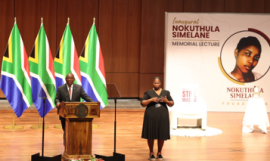
President Cyril Ramaphosa has affirmed a commitment to justice for Nokuthula Simelane, a 23-year-old anti-apartheid activist who disappeared more than four decades ago. This pledge was made during a lecture on Thursday, September 3, 2026, marking a renewed focus on her unsolved case. The President's remarks come as a Judicial Commission of Inquiry, led by retired Constitutional Court Judge Sisi Khampepe, is expected to conclude its work by the end of 2026. The commission's findings are anticipated to shed light on the circumstances surrounding Simelane's disappearance, providing key details in the long-standing quest for accountability. The ongoing pursuit of justice for Ms. Simelane notes the government's dedication to resolving historical injustices from the apartheid era, ensuring that victims and their families receive the truth they have long sought. The lecture served as a powerful reminder of the sacrifices made by individuals like Simelane in the struggle for a democratic South Africa.
Uncovering Simelane's Fate
Former commander Willem Coetzee admitted to the capture and torture of Nokuthula Simelane during proceedings at the Truth and Reconciliation Commission (TRC). While acknowledging his involvement in her detention and ill-treatment, Coetzee consistently denied responsibility for her death. His testimony before the TRC provided insights into the circumstances surrounding Simelane's disappearance, detailing the methods used by the apartheid security forces during her interrogation. However, his account left the ultimate question of her fate unresolved from his perspective, creating a persistent void in the official narrative of her last days. The TRC, established to investigate human rights violations committed during the apartheid period, heard numerous testimonies, but cases like Simelane's often remained partially unresolved due to conflicting accounts and lack of definitive evidence regarding the ultimate fate of victims.
A colleague of Mr. Coetzee, whose identity has not been publicly disclosed, offered a contrasting account, stating that Ms. Simelane had been murdered. This individual further claimed that her body was subsequently buried in the vicinity of Rustenburg, located in the North West province. This assertion directly contradicted Coetzee's denial of involvement in her killing, adding another layer of complexity to the investigation into Simelane's disappearance. The discrepancy between these testimonies has been a significant hurdle in the efforts to bring closure to the case. The location specified by the colleague has been a point of interest for investigators seeking to recover her remains, prompting various search efforts over the years, though without success to date. The conflicting accounts show the challenges in piecing together the events of that period, particularly when dealing with individuals who were part of the security apparatus responsible for such acts.
Criminal charges against Willem Coetzee related to Ms. Simelane's case are still pending. The legal proceedings have faced numerous delays over the years, contributing to the prolonged quest for justice for Simelane's family. These delays have been a source of frustration for activists and Simelane's relatives, who have consistently pushed for the prosecution of those responsible for her abduction, torture, and disappearance. The continuation of these charges signifies an ongoing effort by the state to hold individuals accountable for actions committed during the apartheid era, particularly in cases involving the disappearance and alleged murder of activists. The pending charges show the unresolved nature of the case within the South African legal system, noting the long road still ahead in achieving full justice for victims of political violence. The legal system's commitment to pursuing these charges, despite the passage of time, reflects a broader societal demand for accountability for past atrocities.
President's Pledge for Truth
Nokuthula Simelane, an anti-apartheid activist, was abducted by apartheid security police in 1983. She was subsequently tortured and disappeared in the same year, a fate that has remained a central point of the ongoing investigation. The circumstances surrounding her capture and subsequent disappearance have been the subject of extensive inquiry, including before the Truth and Reconciliation Commission, which sought to uncover the truth about human rights violations during apartheid. The 1983 events marked a tragic turning point in her life, transforming her from an active participant in the liberation struggle into a symbol of the many who vanished without a trace under the brutal regime. The details of her abduction and subsequent torture exemplify the extreme measures taken by the apartheid state to suppress dissent and dismantle opposition movements.
Her remains have never been recovered, despite decades of efforts by her family and various investigative bodies. The failure to locate her body has been a a significant barrier to closure for her relatives and a persistent challenge for legal proceedings aimed at accountability. This lack of physical evidence further complicates the prosecution of those allegedly responsible, as definitive proof of death and burial location remains elusive. The lack of recovery of her remains continues to be a poignant aspect of the case, showing the enduring pain and uncertainty faced by those who knew her. The search for her remains has led investigators to various locations, including the vicinity of Rustenburg in the North West province, based on conflicting accounts from former security police members, yet each search has yielded no definitive answers, leaving the family in a perpetual state of grief and hope.
President Cyril Ramaphosa reiterated the government's commitment to resolving the long-standing case. He emphasized the importance of uncovering the full truth regarding Simelane's abduction, torture, and disappearance. The President’s remarks align with ongoing efforts to address unresolved human rights abuses from the apartheid era, signaling a continued pursuit of justice for victims and their families. His pledge reinforces the state's responsibility to provide answers and ensure that those who committed crimes against humanity are held accountable, regardless of how much time has passed. The administration has indicated that it views the resolution of such cases as integral to national reconciliation and the upholding of human rights principles, asserting that true reconciliation cannot be achieved without confronting the past and delivering justice. This commitment is seen as vital for healing the wounds of the past and building a truly democratic society founded on the rule of law.
Legacy and Ongoing Efforts
The inaugural Nokuthula Simelane Memorial Lecture was held at the University of Mpumalanga, marking a significant step in acknowledging her legacy and the broader struggle against apartheid. The lecture serves as a platform to reflect on Simelane's contributions and the enduring quest for justice for victims of political violence. It aims to educate new generations about the sacrifices made during the liberation struggle and to ensure that the memory of activists like Simelane is preserved. Its establishment at a prominent academic institution shows a commitment to historical preservation and educational outreach regarding the apartheid era's human rights abuses, fostering a deeper understanding of the nation's past. The event brought together academics, activists, and community members, all united in their resolve to honor Simelane's memory and continue the fight for truth and accountability.
Further solidifying her legacy, the Nokuthula Simelane Foundation was launched. This initiative aims to continue advocating for truth and accountability in cases of forced disappearances and human rights violations from the apartheid period. The foundation’s work extends beyond Simelane's individual case, seeking to support other families affected by similar injustices and to promote broader awareness of the historical context of political repression in South Africa. Through its advocacy, the foundation plays a key role in keeping the issue of unresolved apartheid-era cases in the public consciousness and pressuring authorities to expedite investigations and prosecutions. The foundation provides practical support and legal assistance to families, empowering them in their own searches for truth and justice.
Additionally, the Nokuthula Simelane Centre for Gender and Intersectional Studies was established at the University of Mpumalanga. The centre is dedicated to academic research and discourse on issues at the intersection of gender, justice, and social inequality, drawing inspiration from Simelane's struggle as a woman activist. Its creation signifies an institutional commitment to exploring the complex dynamics of gender within historical and contemporary social justice movements, ensuring her name remains associated with academic inquiry and advocacy. The centre aims to contribute to scholarship that addresses the unique challenges faced by women in political struggles and to highlight the often-overlooked gendered dimensions of human rights abuses. Through its research and public engagement, the centre seeks to amplify the voices of marginalized communities and contribute to policy discussions aimed at fostering a more equitable society.