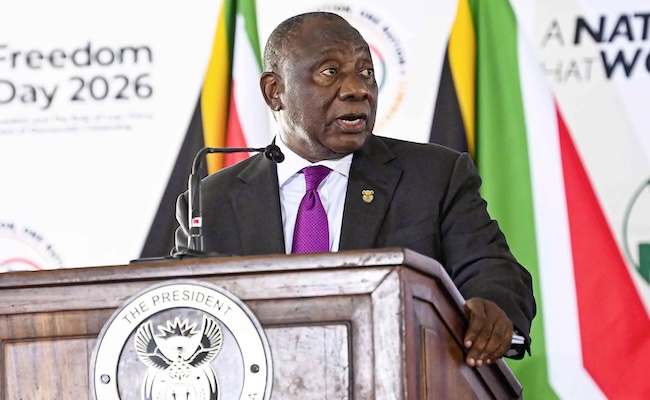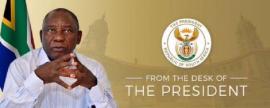
President Cyril Ramaphosa has used his weekly newsletter to call on South Africans to respect and uphold the country's laws, addressing recent anti-immigrant unrest and affirming the government's stance on illegal migration as it tackles the challenge of illegal migration. Demonstrations, some violent, against undocumented immigrants have spread across several major cities in South Africa, reflecting growing tensions. President Ramaphosa stated in his weekly newsletter that "The recent violent protests and criminal acts directed at foreign nationals in parts of our country do not represent the views of South Africa’s people nor reflect our government’s policy. These are the acts of opportunists who are exploiting the legitimate grievances, particularly those of the poor, under the false guise of ‘community activism’." He emphasized that such lawlessness would not be tolerated, making it clear that violence and criminal acts against foreign nationals are unacceptable.
Ramaphosa asserted that South Africa needs to deal "decisively – and within the law" with illegal immigration, which he views as a risk to the country’s "social stability, governance and national security." He declared, "There is no place in South Africa for xenophobia, ethnic mobilisation, intolerance or violence." The President also affirmed that "Everyone in South Africa is bound by the same laws and we are committed to ensuring that they are respected and upheld by citizens and foreign nationals alike." This commitment extends to ensuring that legal processes are followed in all matters concerning immigration and national security.
Challenges of Undocumented Migration
President Cyril Ramaphosa has acknowledged that undocumented migration presents several challenges for South Africa, including unauthorized actions by some individuals. Ramaphosa stated that "Some of these people are assuming functions that only state officials are permitted to perform, including stopping people to check identification and conducting searches of private property." He emphasized that "Such lawlessness will not be tolerated, regardless of who the perpetrators or victims are." These unauthorized actions, he noted, undermine the authority of the state and can lead to further instability.
Ramaphosa also noted the systemic pressures caused by undocumented migration, noting that "Undocumented migration places strain on healthcare, housing and municipal services, particularly in poor communities." He further identified its impact on the economy, stating that it "distorts the labour market." The President observed that "Many South Africans are exploiting undocumented labour in households and in the informal sector," contributing to the complex issue. This exploitation, he suggested, exacerbates the challenges faced by both documented and undocumented workers and creates an unfair playing field.
Addressing the broader context, Ramaphosa pointed out that South Africa's experience is not isolated. He said, "South Africa is not unique in confronting the pressures associated with undocumented migration. Many countries across the world, including in Africa, are themselves grappling with similar tensions. This calls for cooperation and understanding between countries on the continent and further afield." This global perspective shows the need for collaborative solutions and shared responsibilities in managing migration flows.
Government's Enforcement Strategy
The South African government is intensifying its efforts to manage migration, with the Border Management Authority (BMA) and the Defence Force actively working to strengthen national borders and combat illegal cross-border activities. This strategy aims to enhance security and regulate entry into the country, ensuring that all entries are legal and properly documented. Both entities are coordinating their operations to create a more secure and controlled border environment.
In the past financial year, the Border Management Authority has reported intercepting approximately 450,000 individuals attempting to enter South Africa illegally. These interceptions highlight the scale of unauthorized movements that the BMA is addressing at the country's points of entry and along its extensive land borders. This substantial number demonstrates the ongoing efforts and the significant challenges involved in securing the nation's boundaries.
Further bolstering its enforcement capabilities, the government plans to significantly expand its inspection workforce. The Department of Labour and Employment is slated to hire up to 10,000 new inspectors. These new personnel will be tasked with ensuring compliance with existing labour laws and immigration regulations across various sectors, addressing concerns about the exploitation of undocumented workers and adherence to national employment standards. This expansion shows the government's commitment to both protecting workers' rights and ensuring regulatory compliance.
President Cyril Ramaphosa affirmed the nation's sovereign authority in managing its borders and laws, stating that South Africa will exercise its sovereign right to "regulate migration, secure our borders and enforce our laws." This declaration shows the government's commitment to maintaining control over its national boundaries and ensuring that all individuals within its territory abide by its legal framework. The full approach combines enhanced border security with increased internal enforcement to manage the challenges associated with undocumented migration, aiming for a balanced and effective strategy.
Upholding Law and National Reputation
President Cyril Ramaphosa emphasized the importance of maintaining South Africa's international standing, stating that citizens must actively counter efforts to damage the country's reputation. He noted that unlawful acts, such as vigilantism and violence against foreign nationals, undermine the nation's commitment to the rule of law and democratic principles. Such actions, he noted, contradict the values enshrined in the South African Constitution, which guarantees human rights for everyone within its borders. He urged South Africans to push back on attempts to tarnish the country’s reputation, reminding them that the nation's image is built on its adherence to justice and human dignity.
Ramaphosa's message showed that while addressing legitimate concerns about undocumented migration, the methods employed must always align with legal frameworks. He asserted that the government is resolute in its commitment to enforce laws fairly and without prejudice, ensuring that both citizens and foreign nationals are held to the same standards. The President’s remarks serve as a call for national unity against xenophobic sentiments and criminal behavior, which he previously denounced as the work of opportunists.
The government's strategy, as outlined by Ramaphosa, involves a dual approach: strong border management and internal enforcement of immigration and labor laws, coupled with a firm stance against any form of lawlessness. This aims to secure the country's borders and regulate migration effectively, while simultaneously protecting the rights of all individuals and upholding the nation's reputation on the global stage. Ramaphosa reiterated that South Africa's commitment to human rights and the rule of law must remain unwavering, serving as a cornerstone of its national identity and international relations.