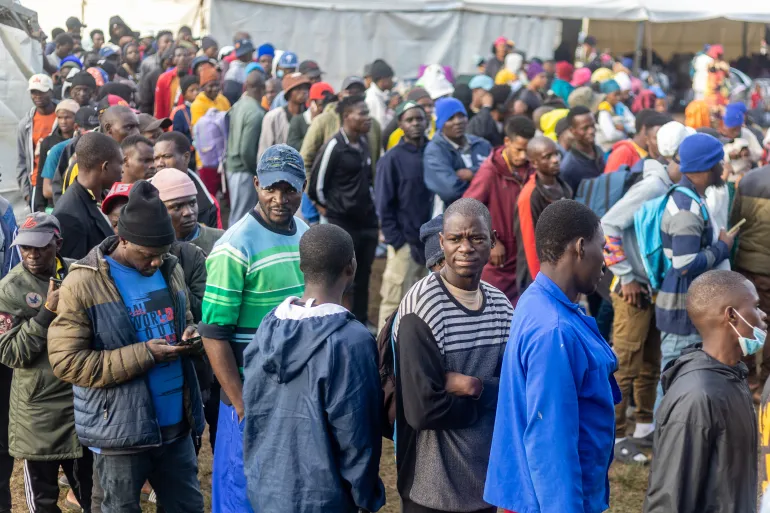
President Cyril Ramaphosa delivered an address to the nation on Sunday, outlining a full five-point strategy aimed at tackling illegal immigration in South Africa. The President's address showed the urgency of addressing the multifaceted challenges posed by undocumented migration and the systemic issues that exacerbate it. He presented this five-point strategem to tackle illegal immigration, emphasizing both enforcement and internal reforms.
The plan focuses on several key areas, including intensifying workplace compliance inspections to ensure legal employment practices and prevent the exploitation of undocumented workers. This measure aims to hold employers accountable for adhering to labor laws and verifying the legal status of their workforce. Additionally, the strategy involves enhancing border infrastructure to improve control and security at the country's entry points, a critical step in managing the flow of people and goods across South Africa’s extensive borders. Ramaphosa's proposals also include leveraging digital technologies to streamline processes, enhance data management, and prevent illicit activities, thereby modernizing the immigration system. A significant component of the plan is rooting out internal corruption within the Department of Home Affairs, which has been identified as a widespread factor contributing to the crisis and undermining the integrity of the state. Finally, the President committed to stamping out the illegal selling of identity documents, a practice that severely undermines national security, facilitates illegal residency, and compromises the identity of legitimate citizens.
Deep-Rooted Systemic Corruption
South Africa’s Department of Home Affairs has been plagued by deep-rooted, systemic corruption for more than two decades, creating vulnerabilities that have been exploited by criminal elements. This widespread corruption has allowed for the illicit acquisition of official documents and permits, fueling illegal immigration. Investigations by the Special Investigating Unit (SIU) traced over R181 million (approximately $9.6 million USD) generated by foreign nationals who obtained fraudulent visas, revealing the significant financial scale of these illicit operations. Out of this total, more than R16 million (approximately $850,000 USD) went directly into the pockets of implicated officials, according to the SIU findings, noting the direct involvement of state employees in these criminal enterprises.
This corruption extended to various immigration documents, with around 2,000 study visas reportedly issued fraudulently, allowing individuals to enter or remain in the country under false pretenses. Additionally, thousands of fraudulent resident permits were issued, further noting the extent of the systemic issues and the ease with which official documents could be illegally obtained. The SIU's findings indicate a long-standing pattern of abuse within the system. Criminal syndicates have treated the South African immigration system as a commodity since 1994, systematically exploiting vulnerabilities within the administrative framework for financial gain and undermining national sovereignty. These syndicates have developed sophisticated methods to circumvent legal processes, often in collusion with corrupt officials, leading to a breakdown of integrity within the immigration system.
Escalating Public Sentiment
In April and May 2026, a movement operating under the name March and March organized a series of demonstrations across South Africa that tragically resulted in fatalities. The group, identified as an extremist entity, is led by Jacinta Ngobese-Zuma. These events have significantly contributed to heightened public concern regarding immigration, national stability, and the rule of law. The demonstrations show the volatile nature of public discourse surrounding immigration and the potential for social unrest.
Concurrently, the United States is actively pursuing targeted investments and establishing bilateral partnerships in South Africa. This strategic engagement aims to secure access to critical minerals, which are vital for various industries, including renewable energy, electronics, and defense. The US initiative reflects a broader geopolitical interest in the region's natural resources and is part of its global economic strategy to diversify supply chains and secure essential raw materials. These efforts are part of a wider US foreign policy agenda to strengthen economic ties and strategic alliances across the African continent.
Economic Realities of Migration
Professor Ziyad Motala authored an opinion piece titled “Demonising Africans while courting western parasites,” which offers a critical perspective on perceptions of migration in South Africa. In his analysis, Professor Motala stated, "The poor African migrant encounters suspicion because that migrant competes visibly within spaces of black economic desperation. Such migrants ride the same taxis, work in the same informal markets and queue at the same public hospitals. Their presence is immediate and therefore politically useful as a target of resentment. The European, American or Israeli expatriate, by contrast, arrives wrapped in the aura of Western prestige, whiteness, wealth and global mobility." This commentary notes a perceived double standard in how different migrant groups are viewed and treated within the host country.
The piece also noted that African immigrants, particularly those from Zimbabwe, Malawi, or Ethiopia, are often characterized by a strong work ethic, contributing significantly to various sectors of the economy, particularly in informal markets and essential services. Economic studies from the International Monetary Fund (IMF) and the World Bank suggest that migration generally expands productivity and contributes to the economic growth of host countries over time. These findings indicate a broader pattern where migrant populations can positively impact national economies by filling labor gaps, fostering innovation, and increasing demand for goods and services. The research from these international financial institutions consistently points to the long-term economic benefits that well-managed migration can bring to receiving nations.