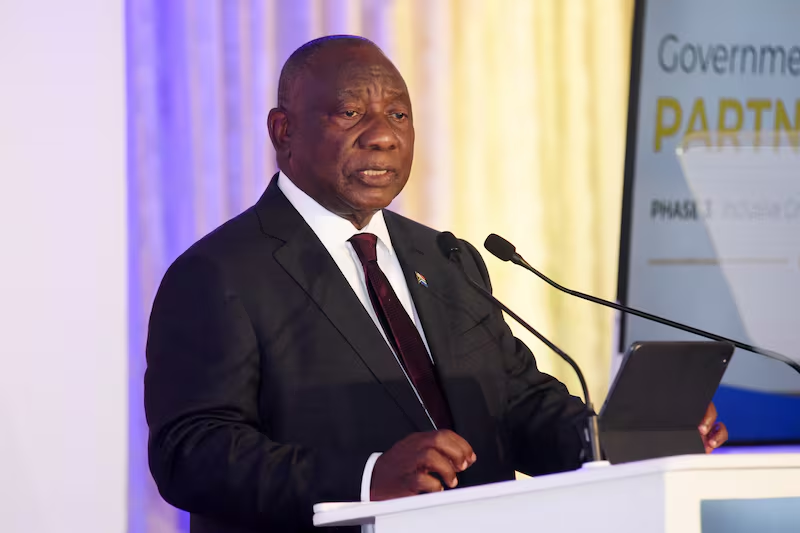
President Cyril Ramaphosa stated in the National Assembly that the South African government is investigating allegations of external forces attempting to influence and instigate violence against foreign nationals. This investigation comes as the government seeks to understand the full scope of factors contributing to anti-migrant sentiment and actions within the country. Responding to questions from EFF leader Julius Malema and DA MP Ryan Smith during oral questions in the National Assembly, President Ramaphosa indicated that African governments acknowledge that "quite a bit" of the anti-migrant activity, though "certainly not all of it," is being propelled and instigated from outside South Africa. This recognition from other African nations shows the complexity of the issue and the potential for external manipulation. He also rejected claims that the nation is losing its standing as a Pan-African voice, asserting that South Africa remains a "respected member" of the African community of nations and a "principled Pan-African actor." This firm stance aims to reassure both domestic and international audiences about South Africa's continued commitment to continental solidarity.
Investigating Foreign Influence and Domestic Incitement
President Cyril Ramaphosa stated that South African police and the security apparatus are actively investigating individuals inciting anti-migrant violence. The President indicated that authorities are gathering reports and evidence to pursue those found responsible. Ramaphosa also noted that "A number of other people have been arrested" in connection with these incidents, signaling ongoing law enforcement efforts. He emphasized that the police and security apparatus are specifically investigating the instigators of this violence, meticulously collecting reports and evidence to ensure accountability for those found to be behind these actions. The government's commitment extends to ensuring all individuals within the country are properly documented, and employers found to be hiring undocumented people will face legal action under the law. This dual approach tackles both the instigation of violence and the underlying issues of irregular migration.
Addressing the broader context of migration, Ramaphosa explained that various factors drive people to South Africa. These include individuals seeking economic opportunities, those fleeing dangerous situations, and refugees searching for security. He further characterized South Africa as being perceived as an "economic oasis," contributing to its appeal for migrants from across the continent. This perception, he noted, draws people to the nation in search of better prospects and safety, creating a complex demographic landscape. The President's remarks noted the multifaceted nature of migration flows into the country, encompassing economic motivations, humanitarian crises, and the pursuit of personal safety.
Defending South Africa's Standing Amidst Reforms
President Cyril Ramaphosa stated that South Africa's migration governance framework is undergoing reforms and modernization efforts. These initiatives include strengthening border management, addressing corruption within the immigration system, and improving legal pathways for migration. The reforms also involve implementing the white paper on citizenship, immigration, and refugee protection, a full document designed to overhaul existing policies. These full changes are designed to create a more orderly and equitable system for all, aiming to balance national security with humanitarian obligations and economic needs.
Mr. Malema's initial query in the National Assembly specifically addressed the impact of anti-migrant and Afrophobic actions on South Africa’s standing within the African continent. In response, President Ramaphosa affirmed the nation's continued good relations with other African countries. He noted the recent Southern African Development Community (SADC) summit hosted by South Africa in eThekwini as evidence of the country's strong regional ties and its ongoing role as a respected member of the African community. This summit served as a tangible demonstration of South Africa's active engagement in regional diplomacy and cooperation. Ramaphosa reiterated that South Africa remains a "principled Pan-African actor," actively engaged in regional and continental affairs and committed to upholding the values of African unity and solidarity.
Parliamentary Exchange on Violence and Sovereignty
President Cyril Ramaphosa stated that the government is working to ensure all individuals within the country are properly documented and that employers of undocumented people face legal action. This commitment reflects a broader strategy to regularize migration and address concerns about undocumented foreign nationals. During the parliamentary exchange, Democratic Alliance (DA) MP Ryan Smith challenged President Ramaphosa on whether South Africa should increase its efforts to address authoritarianism and democratic decline in neighboring countries. Ramaphosa defended the principle of state sovereignty, asserting that South Africa would operate through regional bodies rather than undertaking unilateral actions. He stressed the importance of working collaboratively with other nations through established frameworks to address such complex issues, emphasizing a multilateral approach to regional challenges.
Economic Freedom Fighters (EFF) leader Julius Malema pressed President Ramaphosa for an explanation regarding the alleged failure to arrest and prosecute instigators and perpetrators of anti-migrant violence. Malema specifically questioned why these individuals had not yet been apprehended and brought to justice, noting public frustration. When Malema further pressed for a timeline for arrests and prosecutions, President Ramaphosa declined to provide a specific schedule. He reiterated that the police and security apparatus are actively investigating the instigators, gathering reports and evidence, and pursuing those responsible, but did not commit to a precise timeframe for their apprehension. The President showed the government's commitment to upholding the law and ensuring accountability for all acts of violence, even without specifying an exact timeline for arrests.