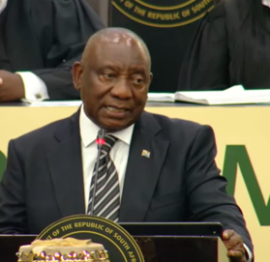
President Cyril Ramaphosa addressed Parliament on Wednesday, delivering his reply to the Presidency Budget Vote debate. During his address, Ramaphosa noted improvements at the state-owned logistics company, Transnet, showing the government's commitment to revitalizing key state-owned enterprises as part of a broader economic recovery strategy. The President's remarks provided a full overview of the nation's economic progress and the strategic initiatives being implemented to foster sustainable growth and job creation.
President Ramaphosa stated that Transnet is now "registering a steady increase in rail volumes and vessel traffic through its ports." He further elaborated on the company's financial health, noting that its financial position is improving, a critical development for a company central to the country's export and import capabilities. Ramaphosa also pointed out that in the last financial year, cargo volumes through Transnet's ports experienced their "strongest growth in 15 years." This significant uptick in performance is indicative of enhanced operational efficiency and a renewed focus on infrastructure development within the state-owned entity. The President emphasized that these improvements are vital for supporting various industries, from mining to manufacturing, which rely heavily on efficient logistics to transport goods to domestic and international markets.
Addressing Youth Unemployment Crisis
The Presidency has showed its commitment to addressing the country's high youth unemployment rates, noting various initiatives designed to integrate young people into the workforce and provide them with valuable skills and opportunities. This year’s South Africa Investment Conference achieved the highest cumulative value of pledges to date, an outcome President Cyril Ramaphosa noted as encouraging for future ambitions. "This year’s South Africa Investment Conference recorded the highest cumulative value of pledges to date, encouraging us to set our ambitions even higher," Ramaphosa said, linking investment directly to potential job creation. These pledges are key for stimulating economic activity across diverse sectors, which in turn generates demand for labor, particularly among the youth.
Recent data from Statistics South Africa’s Quarterly Labour Force Survey in May indicated that individuals aged 15-24 face an unemployment rate of 60.9%. This staggering figure notes the urgent need for targeted interventions to support young people entering the labor market. For those aged 25-34, the unemployment rate stands at 40.6%, further emphasizing the widespread challenge of youth joblessness across different age brackets. These statistics show the demographic pressures and the critical importance of government-led programmes aimed at skills development, job placement, and entrepreneurship.
In response, the Presidential Employment Stimulus has created work and livelihood opportunities for more than 2.5 million unemployed South Africans. This extensive programme is a cornerstone of the government's strategy to mitigate the impact of unemployment, providing immediate relief and pathways to more sustainable employment. The Basic Education Employment Initiative provided work experience for nearly 200,000 young people in schools across the country last year. President Ramaphosa stated, "Last year, the Basic Education Employment Initiative provided work experience for nearly 200,000 young people in schools across the country, with support also provided to social employment, the creative sector, metros and the National Youth Service." This initiative not only offers practical experience but also addresses critical needs within the education system and other public services, creating a dual benefit.
The National Pathway Management Network continues its expansion efforts, serving as a critical bridge between young job seekers and available opportunities. President Ramaphosa reported that "more than 900,000 young people joining SA Youth mobi in the last year, increasing the number of young people on the platform to 5.7 million." The SA Youth mobi platform now connects 5.7 million young people with various opportunities, including educational programmes, training courses, and job placements, demonstrating its growing reach and impact in the fight against youth unemployment. This digital platform plays a key role in streamlining access to resources and fostering a more connected and informed youth workforce.
Driving Economic Reforms and Investment
President Cyril Ramaphosa credited the Energy Action Plan, Eskom’s generation recovery programme, and substantial investment in renewable generation with ending load shedding. Ramaphosa stated, "Through the implementation of the Energy Action Plan, through Eskom’s generation recovery programme, through the massive investment in renewable generation, we have in effect brought load shedding to an end." This initiative aims to stabilize the national power grid and support economic activities that have been hampered by electricity supply interruptions, which have long been a major impediment to economic growth and investor confidence. The focus on renewable energy sources is part of a broader strategy to diversify the country's energy mix and enhance energy security, reducing reliance on aging coal-fired power plants and embracing cleaner, more sustainable energy solutions. This transition is expected to attract further green investments and create new job opportunities in the renewable energy sector.
The South Africa Investment Conference has played a key role in attracting significant capital, with R1.5 trillion in investment pledges secured over its first five years. These pledges are intended to stimulate economic growth and job creation across various sectors of the economy, from manufacturing to technology. The conference serves as a vital platform for showcasing investment opportunities and fostering partnerships between local and international businesses, thereby promoting foreign direct investment and domestic capital formation. Securing such substantial commitments aligns with the government's objective of positioning the country as an attractive destination for global investors, noting its potential and commitment to a stable and growing economy.
In the last financial year, Transnet’s ports recorded their strongest growth in cargo volumes in 15 years. This performance indicates an improvement in the efficiency and capacity of the national logistics infrastructure, which is key for international trade and overall economic activity. Increased cargo throughput at ports can signify a rebound in industrial output and export demand, reflecting healthier economic conditions. The growth observed in Transnet's operations suggests ongoing efforts to enhance the capabilities of state-owned enterprises involved in critical economic infrastructure, ensuring they can effectively support the country's trade ambitions.
Vision for a Prosperous Future
Operation Vulindlela is actively implementing reforms across key economic sectors, including electricity, telecommunications, logistics, water management, and the national visa system. These efforts are part of a broader governmental strategy to enhance efficiency and competitiveness, removing bottlenecks that have historically hindered economic progress. The reforms are designed to create a more business-friendly environment, attract further investment, and improve the delivery of essential services to citizens and businesses alike. The full nature of these reforms demonstrates a concerted effort to address foundational issues that underpin economic performance.
From the total investment pledges secured, R634 billion has already been directed towards various projects. These investments include the establishment of new factories, the development of new production lines, the opening of new mines, the construction of renewable energy plants, the creation of data centres, and the acquisition of new machinery. This substantial capital deployment shows the tangible progress made in translating investment commitments into operational economic activities, generating jobs and contributing to the nation's productive capacity. The diversity of these projects reflects a broad-based economic revitalization, touching multiple sectors and fostering innovation and industrial growth. The President’s address painted a picture of a proactive government, committed to overcoming challenges and building a more inclusive and prosperous future for all South Africans through strategic economic growth and targeted interventions.