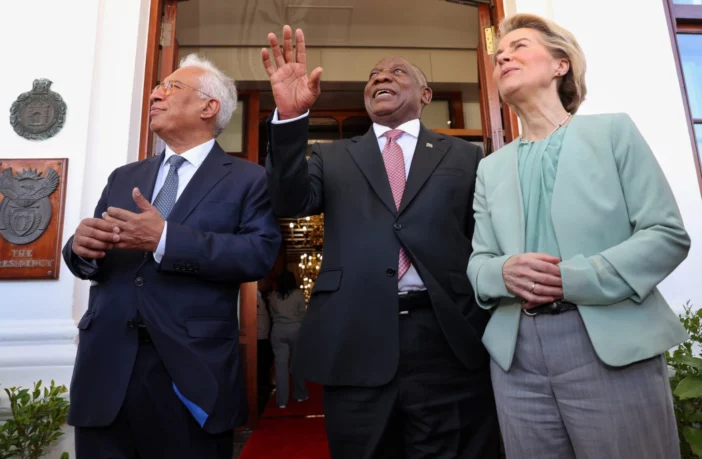
President Cyril Ramaphosa faces calls to address the Phala Phala matter directly and transparently. The demand emphasizes that President Ramaphosa should deal with the issue swiftly and with honesty. This recommendation comes as part of broader discussions concerning South Africa's foreign policy and its impact on the country's economic prosperity. Indeed, South Africa’s international relations policy should urgently be addressed to navigate the complex global landscape effectively.
Addressing Phala Phala's Shadow
President Cyril Ramaphosa continues to face scrutiny regarding the Phala Phala matter, which has drawn attention from political parties and international observers ahead of key engagements. The Freedom Front Plus (VF Plus) has called for an independent investigation into the allegations surrounding the Phala Phala farm. Dr. Pieter Groenewald, leader of the VF Plus, stated that the matter directly impacts investor confidence in South Africa. He emphasized that resolving the issue is key for maintaining the country's economic standing, particularly in discussions with international partners like the United States.
Groenewald further noted that the lack of transparency surrounding Phala Phala undermines South Africa's credibility on the global stage, potentially affecting its ability to attract foreign investment. The ongoing questions about the incident could complicate President Ramaphosa's efforts to project stability and good governance, factors essential for fostering economic prosperity and strengthening diplomatic ties, especially within Africa and the Middle East. The political pressure shows the perceived link between domestic accountability and international economic perception. This persistent cloud over the presidency continues to be a significant concern for both domestic and international stakeholders.
Rethinking US Relations
South Africa’s international relations policy requires urgent attention, particularly its approach to the United States. Pretoria will need to reassess specific elements of its policy towards the United States. South Africa will have to rethink certain aspects of its policy towards the United States (US) to align with evolving global dynamics. The United States maintains its position as the world’s largest economy and possesses the strongest military. This economic and military standing shows its global influence, making it an indispensable partner for many nations. Both nations currently communicate through ambassadorial representation, indicating a formalized diplomatic channel. Both countries are now represented at ambassadorial level, signifying the established nature of their diplomatic ties. This level of engagement provides a foundation for addressing complex bilateral issues and exploring new avenues for cooperation.
Critical Minerals Pact Potential
South Africa possesses the potential to provide strategic access to the exploration, mining, and particularly the refining of critical minerals such as platinum group metals, manganese, vanadium, rare earth elements, and titanium. South Africa could offer strategic access to the exploration, mining and especially the refining of platinum group metals, manganese, vanadium, rare earth elements and titanium, resources vital for global industries. Establishing a critical minerals exchange in Johannesburg, connected to US commodity markets, could unlock vital supply chains and position South Africa as a global hub for processing and trading these resources. A Johannesburg-based critical minerals exchange, linked to US commodity markets, could unlock supply chains and position South Africa as a global processing and trading hub, drawing significant international attention and investment. Such a minerals agreement is projected to increase South Africa’s GDP by $40 billion. This initiative could generate approximately 500,000 jobs, driving economic growth to 5% annually and effectively halving unemployment over time. This minerals agreement could create approximately 500,000 jobs, providing substantial relief to the country’s high unemployment rates. It would drive up economic growth to 5% per year, a significant boost for the national economy. It would halve unemployment over time, addressing one of the most pressing socio-economic challenges facing the nation. For the United States, direct gains from minerals, gas exports, and agriculture resulting from this pact are estimated to exceed $75 billion. This mutual benefit notes the potential for a truly transformative partnership.
Path Forward and Support
South Africa's measures and guidelines for the effective coordination of international engagements were initially approved in 2009. The country’s measures and guidelines for the effective coordination of international engagements were approved in 2009, providing a framework for its diplomatic activities. The Freedom Front Plus (VF Plus) has expressed support for governmental processes, indicating a willingness to collaborate on future initiatives. A representative for the party stated that the Freedom Front Plus is willing to walk with government every step of the way. This collaborative stance suggests a potential for cross-party cooperation on matters of national interest, particularly concerning South Africa's foreign policy and economic development strategies. Continued adherence to established guidelines could streamline international interactions and enhance the country's diplomatic efforts. This bipartisan approach could be instrumental in steering South Africa towards greater economic prosperity and a stronger international standing.