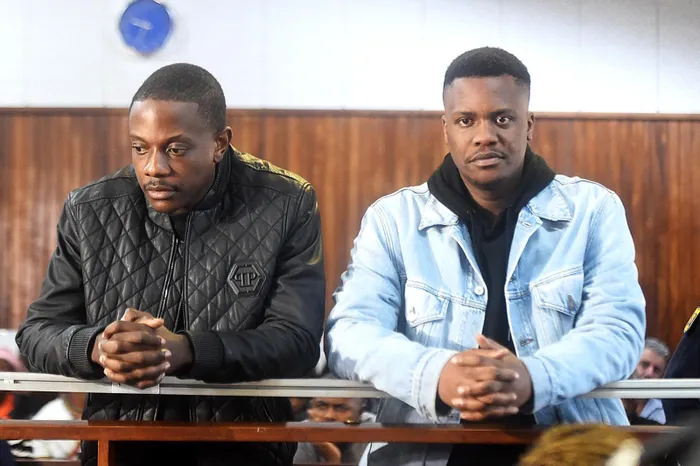
A South African court on Wednesday ordered the deportation of Bellarmine Chatunga Mugabe, the 29-year-old son of Zimbabwe's former leader Robert Mugabe, after he pleaded guilty to being in South Africa illegally and brandishing a toy gun in an unrelated incident. Bellarmine Mugabe admitted to the illegal residency and was instructed to pay approximately $36,000 in fines or face two years in prison. Reports indicated the court ordered his immediate deportation, with police tasked to escort him to Johannesburg's OR Tambo International Airport. Bellarmine Chatunga Mugabe has been in custody since mid-February. He was held alongside his cousin and co-accused, Tobias Mugabe Matonhodze.
Bellarmine Mugabe and his cousin, Tobias Matonhodze, 32, were arrested on February 19. Matonhodze pleaded guilty to attempted murder and other charges, receiving concurrent prison terms of up to three years. Matonhodze will be deported from South Africa after serving his sentence. The firearm used in the shooting incident has not yet been recovered.
Guilty Pleas and Sentencing
Bellarmine Mugabe was implicated in the shooting of a gardener following an altercation, according to reports. He and his cousin, Tobias Matonhodze, initially faced charges of attempted murder related to the shooting of an employee at Mugabe’s home in Johannesburg. These attempted murder charges stemmed from an incident at the family's residence in Johannesburg's Hyde Park district. Police were called to Mugabe's home in the Hyde Park suburb of Johannesburg following the shooting of a 23-year-old man who worked at the premises. The man was subsequently taken to hospital in a critical condition after being shot. Prosecutors informed the court that the shooting occurred after a disagreement between the three men inside the property. Reports indicated the victim was shot twice in the back outside as he attempted to flee the scene.
The Alexandra Magistrates' Court fined Bellarmine Mugabe R600,000 rand on two counts, with an alternative of 24 months' imprisonment if the fine was not paid. Investigators told the court that the gardener involved had received R250,000 rand in cash, with an additional R150,000 promised. Mugabe paid £26,700 as part of the fine. Bellarmine Mugabe, 29, admitted to being in South Africa illegally and was ordered to pay around $36,000 in fines or serve two years in prison. The court imposed a significant financial penalty, reflecting the gravity of the offenses to which he pleaded guilty. The R600,000 rand fine, equivalent to approximately $36,000, showed the legal consequences of his actions in South Africa. The alternative of 24 months' imprisonment if the fine was not paid noted the court's determination to ensure compliance with its ruling. The specific payment of £26,700 by Mugabe as part of this fine indicated a partial fulfillment of the financial obligation imposed by the court.
His co-accused and cousin, Tobias Matonhodze, pleaded guilty to multiple charges. Matonhodze admitted to attempted murder, illegal immigration, possession of ammunition, and defeating the ends of justice. He received concurrent prison terms of up to three years. The charges against Matonhodze were extensive and serious, including a plea of guilty to attempted murder, which is a grave offense under South African law. His admission to illegal immigration further complicated his legal standing in the country. The possession of ammunition without proper authorization added another layer to his criminal liability, while defeating the ends of justice suggested attempts to obstruct the investigation or judicial process. The concurrent prison terms of up to three years indicated that he would serve these sentences simultaneously, rather than consecutively. Matonhodze, 32, will be deported from South Africa after serving his sentence, ensuring his removal from the country once his judicial obligations are met.
Bellarmine Mugabe was previously charged with attempted murder in connection with the shooting. However, he pleaded guilty to lesser charges unrelated to the shooting as part of a deal with prosecutors. Earlier this month, he pleaded guilty to pointing a firearm. Additionally, he admitted to illegally being in South Africa. Bellarmine Mugabe pleaded guilty to brandishing an object “likely to lead a person to believe it is a firearm” (a toy gun) in a separate, unrelated incident, and being in South Africa illegally. The initial attempted murder charge stemmed from the shooting incident involving the gardener, but the subsequent plea agreement with prosecutors saw these more severe charges dropped in favor of lesser offenses. His plea of guilty to pointing a firearm, specifically a toy gun, in an unrelated incident, indicated a separate legal infraction. His admission to illegally being in South Africa was a direct violation of immigration laws, leading to the court's deportation order. The court's decision to accept these lesser pleas as part of a deal with prosecutors allowed for a resolution without a full trial on the more serious attempted murder allegations.
Background and Previous Incidents
Robert Mugabe, who led Zimbabwe for 37 years, ruled the nation for almost four decades until he was deposed in a coup in 2017. He was in power for 37 years before being ousted in a 2017 coup. Robert Mugabe died two years later in 2019 at the age of 95. Robert Mugabe died in 2019. Bellarmine Mugabe is one of two sons Robert Mugabe had with his second wife, Grace. Reports indicated Grace Mugabe was accused of assaulting a model in 2017, allegedly beating her with an electrical cord at a luxury Johannesburg hotel while her sons were present. Grace Mugabe was accused of assaulting a model by beating her with an electrical cord in the presence of her sons at a luxury Johannesburg hotel in 2017. The family's history has been marked by various controversies, both political and personal, during and after Robert Mugabe's long tenure as president. Robert Mugabe's rule, which spanned nearly four decades, was characterized by significant political and economic shifts in Zimbabwe. His ousting in 2017 marked a dramatic end to his prolonged leadership, followed by his death at 95 in 2019. The accusations against Grace Mugabe in 2017, involving an alleged assault at a luxury hotel in Johannesburg, drew international attention and noted the family's presence and activities in South Africa. This incident, reportedly occurring in the presence of her sons, including Bellarmine, further showed the family's often tumultuous public image.
Bellarmine Mugabe has also faced legal issues in Zimbabwe. In 2024, he was arrested for allegedly assaulting a police officer in Beitbridge. A warrant for his arrest was subsequently issued in Zimbabwe after he failed to appear in court for that incident. In the following year, he was arrested again, this time for assaulting a security guard at a mining site in Mazowe. These incidents in his home country paint a picture of recurring brushes with the law, predating his recent troubles in South Africa. The alleged assault on a police officer in Beitbridge in 2024 led to a warrant for his arrest being issued when he did not attend court, indicating a pattern of non-compliance with legal proceedings. His subsequent arrest for assaulting a security guard at a mining site in Mazowe further illustrates these ongoing legal challenges. These documented legal problems in Zimbabwe provide context to his more recent criminal charges and deportation from South Africa.
Legal Proceedings and Deportation
Bellarmine Chatunga Mugabe, son of Zimbabwe's former leader, has been in custody since mid-February alongside his cousin and co-accused, Tobias Mugabe Matonhodze. Police were called to Mugabe's home in the Hyde Park suburb of Johannesburg following the shooting of a 23-year-old man who worked at the premises. The man was subsequently taken to hospital in a critical condition after being shot. Reports indicated the victim was shot twice in the back outside as he attempted to flee the scene. The initial police response to the shooting at the Hyde Park residence marked the beginning of the legal process for Bellarmine Mugabe and Tobias Matonhodze. The severity of the victim's injuries, being shot twice in the back and requiring hospitalization in critical condition, showed the violent nature of the incident. Prosecutors told the court the shooting followed a row between the three men inside the property, providing insight into the circumstances that led to the violence. The fact that the victim was shot as he tried to flee further emphasized the aggressive nature of the altercation. The firearm used in the shooting has not been recovered, which remained an outstanding detail in the investigation.
Mugabe was previously charged with attempted murder in connection with the shooting. However, he pleaded guilty to lesser charges unrelated to the shooting as part of a deal with prosecutors. Earlier this month, he pleaded guilty to pointing a firearm. Additionally, he admitted to illegally being in South Africa. Following a Johannesburg court order, Bellarmine Mugabe subsequently arrived in Zimbabwe. He arrived in Zimbabwe following an order from a Johannesburg court. The court ordered his immediate deportation, with police to escort him to Johannesburg's OR Tambo International Airport. The resolution of Mugabe's case through a plea deal, which saw the attempted murder charges reduced to lesser offenses including pointing a firearm and illegal residency, allowed for a swift conclusion to the legal proceedings. His admission to illegally being in South Africa was a key factor in the court's decision to order his immediate deportation. The process of his removal from South African territory was clearly defined, with police assigned to escort him directly to Johannesburg's OR Tambo International Airport to ensure his prompt departure. His subsequent arrival in Zimbabwe confirmed the execution of the court's deportation order, marking the end of his legal entanglement in South Africa and his forced return to his home country.