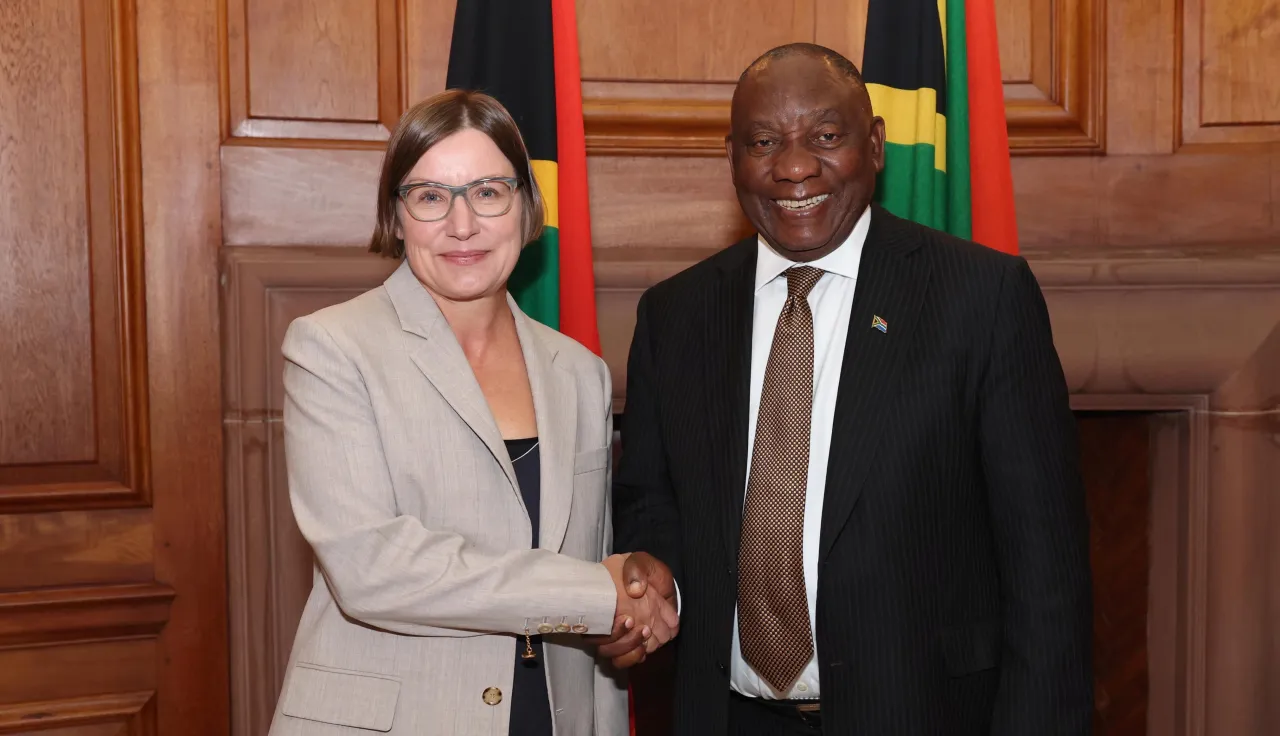
International Committee of the Red Cross (ICRC) President Mirjana Spoljaric met with South African President Cyril Ramaphosa in Pretoria to discuss humanitarian law amidst an increase in global conflicts. The high-level meeting, held in the South African capital, brought together key figures to address pressing global humanitarian challenges. The meeting, which also included South African Minister of International Relations and Cooperation Ronald Lamola, emphasized making respect for the rules of war a political priority. This focus comes at a critical time, as discussions centered on the growing number of armed conflicts worldwide, a trend that continues to have devastating consequences for civilian populations.
During their extensive dialogue, Spoljaric and Ramaphosa noted the urgent need for strong international cooperation to protect civilians and ensure unwavering adherence to international humanitarian law (IHL). Their shared commitment showed the importance of collective action in mitigating the human cost of conflict. The engagement further shows South Africa's significant and proactive role in advocating for humanitarian principles on the global stage, positioning the nation as a key voice in these key discussions.
Global IHL Initiative Gains Traction
South Africa stands as one of the six founding states of the Global International Humanitarian Law (IHL) Initiative, a significant collaborative effort that was officially launched in September 2024. This new initiative seeks to galvanize political commitment to international humanitarian law, aiming to strengthen its application and respect across the globe. Since its inception, the initiative has drew substantial international support. To date, 118 states have officially joined the effort, demonstrating widespread international engagement and a growing consensus on the importance of IHL.
Among these participating nations, 27 African countries have become members, reflecting a significant regional uptake and a strong commitment from the continent to uphold humanitarian principles. This broad participation notes a collective desire to reinforce the rules that govern armed conflict and protect those most vulnerable. The initiative will further advance its objectives at a high-level conference scheduled to be hosted by His Majesty King Abdullah II ibn Al Hussein in Jordan on December 7. This upcoming event is expected to bring together world leaders and humanitarian experts to discuss concrete steps towards ensuring greater respect for IHL.
ICRC's Enduring Presence in South Africa
President Mirjana Spoljaric also met with Advocate Mothibedi Panyane, president of the South African Red Cross Society, during her visit, further solidifying the strong partnership between the international and national Red Cross movements. The International Committee of the Red Cross (ICRC) has maintained a continuous and impactful presence in South Africa since 1963, establishing a long-standing engagement with the nation and its people. Its initial work in the country involved conducting key visits to prisoners, including the late President Nelson Mandela during his incarceration on Robben Island. This historical commitment shows the ICRC's sustained efforts in humanitarian aid and protection within South Africa, dating back to some of the country's most challenging periods.
Currently, the ICRC collaborates extensively with the South African government, the Southern African Development Community (SADC), and various partners throughout the region. This collaborative approach allows the ICRC to address complex humanitarian challenges effectively across Southern Africa. President Spoljaric emphasized the critical nature of upholding international humanitarian law, stating, "Today we see the horrific humanitarian consequences resulting from the rules of war being bent, broken or outright ignored." She further acknowledged South Africa's significant role, adding, "As one of the six founding states of the Global IHL Initiative, South Africa is playing a critical role in reviving respect for these life-saving rules globally." Spoljaric noted the continent's particular vulnerability to conflict, remarking, "With over one-third of armed conflicts taking place in Africa, I hope more countries across the continent will join this exceptional effort to unite states around a shared commitment to preserve humanity in war." This plea shows the urgent need for increased engagement from African nations in the Global IHL Initiative.
Advocacy for Humanitarian Principles
The International Committee of the Red Cross (ICRC) actively delivers life-saving aid across front lines in various conflict zones, often operating in extremely challenging and dangerous environments. This critical assistance includes providing essential resources such as food, clean water, vital medical supplies, and emergency shelter to populations severely affected by armed conflicts. Beyond direct material aid, the organization also works tirelessly to reconnect families separated by war, a profoundly important service that helps alleviate the immense suffering caused by displacement and uncertainty. The ICRC strives to locate individuals who have gone missing amidst hostilities, offering a vital service to those impacted by displacement and uncertainty. Its operations span numerous regions, addressing immediate humanitarian needs in complex and often dangerous environments, demonstrating its global reach and commitment.
In addition to its direct assistance, the ICRC advocates vigorously for the humane treatment of detainees in accordance with international standards. The organization conducts regular and confidential visits to places of detention to monitor conditions and ensure that the rights and dignity of those deprived of their liberty are upheld, working to prevent ill-treatment and ensure basic protections. The ICRC consistently urges all parties to armed conflicts to comply with international humanitarian law. This advocacy seeks to limit the effects of war on civilians and ensure that fundamental rules protecting humanity are respected, even during the most intense hostilities. The ICRC’s unwavering commitment to these principles is central to its mission to protect the lives and dignity of victims of armed conflict and other situations of violence.