Residents in Durban's Sydenham and Sherwood communities are organizing to counter persistent land invasions, expressing concerns for their safety and stability amidst illegal encroachments. These residents of Durban's Sydenham and Sherwood areas are banding together to combat ongoing land invasions that threaten the fabric of their neighborhoods. They are fearing for their community's safety and stability due to these illegal encroachments, which have become a source of significant distress. The escalating tensions are reportedly linked to the upcoming Local Government Elections, with organized groups allegedly attempting to seize land for electioneering purposes ahead of the November 2026 polls. Vacant land pockets have been targeted by invaders for over a year, with these vacant pockets of land having been under attack from land invaders for more than a year, creating a prolonged period of uncertainty for local residents. Specific invasion sites include Loon Road, Crouch Road, Candela Road, Locksley Drive, and Piedmont Road. Additionally, a space known as the "nursery" along King Cetshwayo Highway, previously identified as Jan Smuts Highway, has also been affected by these encroachments.
Escalating Invasions and Community Response
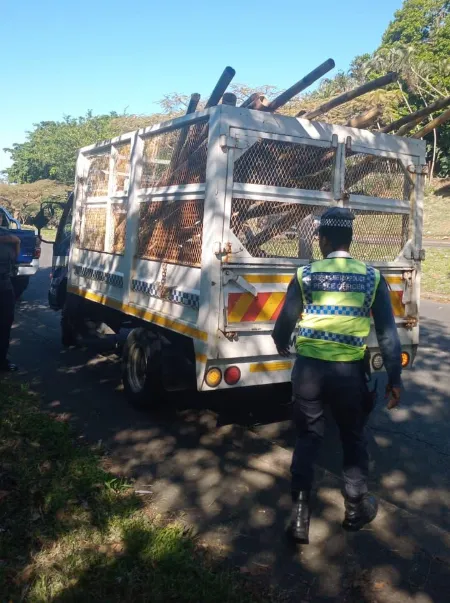
Authorities recently removed sheets of corrugated iron from a vacant plot, a visible sign of the ongoing efforts to reclaim illegally occupied land. These sheets of corrugated iron were recently removed from a vacant plot by authorities, showing the proactive measures being taken. In response to the escalating situation, a dedicated WhatsApp group has been established to facilitate communication, raise awareness, and enable residents to report incidents to authorities, thereby uniting the community against land invasions. This WhatsApp group has been created specifically to inform residents, create awareness about the scale of the problem, report incidents to authorities, and ultimately unite residents in their collective efforts against land invasions. On Sunday, Durban metro police cleared a pile of trees from the pavement in the nursery area along King Cetshwayo Highway. This action by the Durban metro police on Sunday, removing a pile of trees from the pavement in the nursery area, notes the continuous nature of these operations aimed at deterring further illegal occupation.
Residents in the Piedmont area have been contending with the expansion of a shack settlement that is encroaching on their private properties. This particular challenge has seen residents of the Piedmont area grappling with the expansion of a shack settlement that is steadily encroaching on their properties, causing significant concern and potential damage. Following a meeting between residents and illegal invaders, petrol bombs were thrown at the doorsteps of rate-paying residents during the early hours of the morning, resulting in damage to private property. This alarming incident, where petrol bombs were thrown at rate-paying residents' doorsteps during the early hours of the morning after a meeting with illegal invaders, caused direct damage to private property and instilled fear within the community. Metro police officers later removed approximately 32 sheets of corrugated iron from another property, which were intended for the construction of shacks. These metro police officers removed about 32 sheets of corrugated iron from a property, which were clearly intended for erecting shacks, preventing further illegal construction. The Land Invasion Unit's (LIU) current staff complement of 70 personnel has been deemed insufficient to adequately monitor, prevent, and respond to the volume of land invasion activities occurring in the area. The LIU's current staff complement of 70 personnel was deemed insufficient to monitor, prevent, and respond effectively to the widespread land invasion activities.
Political Undercurrents and Election Tactics
Land invaders have constructed over 600 houses on Blinkbonnie Road in Bonela without official building plans. These land invaders have built more than 600 houses on Blinkbonnie Road in Bonela, all without the necessary building plans, illustrating the scale of unauthorized development. These actions are perceived by some as politically motivated, with claims that organized groups are attempting to steal land in the run-up to the Local Government Elections in November 2026 for electioneering purposes. An anonymous group member stated, "There is an attempt to change the voter profile and support base in municipal wards 30 and 31. Residents must stand united to stop this. Every single resident has to get involved." This sentiment shows the belief that the land invasions are not merely opportunistic but are part of a calculated strategy to influence future election outcomes by altering the demographic landscape of key municipal wards. The deliberate nature of these encroachments, particularly the construction of numerous unplanned structures, suggests a coordinated effort rather than isolated incidents.
The Land Invasion Unit (LIU) presented its strategy, plan, and challenges to the Executive Committee in February 2026. This presentation noted the complexities faced by the unit in managing land encroachments, detailing the significant obstacles in their mission. In February 2026, the Land Invasion Unit (LIU) formally presented its strategy, plan, and the numerous challenges it faces to the Executive Committee, laying bare the difficulties of their mandate. To address potential land invasion risks during the upcoming election period, the LIU implemented a learnership programme. Through this initiative, the unit employed 88 learners to augment its operational capacity, significantly boosting its personnel to better cope with the anticipated surge in land invasion attempts. This measure was a direct response to the need for increased manpower to monitor and respond to land invasion risks, particularly in the sensitive period leading up to the elections. The employment of these 88 learners through a learnership programme was a strategic decision to augment the LIU's operational capacity, providing much-needed support.
Broader Context and Municipal Challenges
The eThekwini Municipality's Land Invasion Unit (LIU) required a training budget of R3 million to provide additional tactical training for its learners. This funding was necessary to enhance the unit's capacity to manage and respond to land encroachment incidents effectively, ensuring that the newly recruited personnel are adequately prepared for the demanding nature of their work. The LIU required a training budget of R3 million specifically for additional tactical training for these learners, emphasizing the specialized skills needed for their role. The municipality faces a significant challenge in addressing informal housing, with more than 600 informal settlements recorded across the eThekwini Municipality. These more than 600 informal settlements recorded across the eThekwini Municipality present a vast and persistent challenge for the local authorities. These settlements often arise from land invasions, placing strain on municipal resources and planning, and complicating urban development efforts. The proliferation of informal settlements notes the broader issues of housing demand and urban development pressures within the region, indicating a systemic problem that extends beyond individual acts of invasion. The LIU's need for a substantial training budget shows the complex and often confrontational nature of land invasion prevention and resolution efforts, requiring well-trained and equipped personnel. The extensive number of informal settlements documented by the eThekwini Municipality indicates a persistent and widespread challenge that requires ongoing intervention and strategic resource allocation from local authorities, pointing to a long-term struggle against unauthorized land occupation and the urgent need for full housing solutions. The continuous efforts by residents and municipal units alike highlight the severity of the situation and the commitment to safeguarding community stability and the rule of law in Durban.