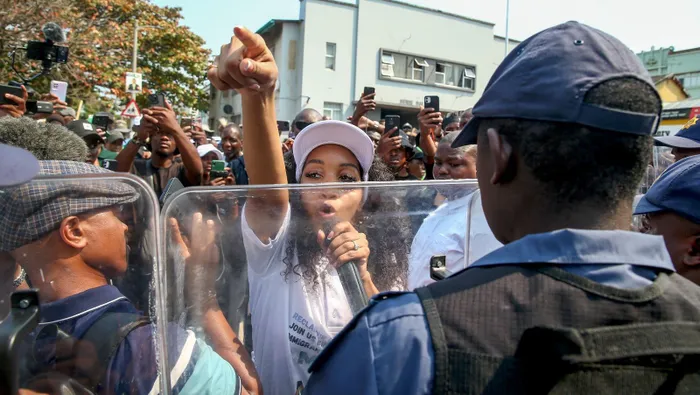
A protest organized by the anti-illegal immigration group, March and March, occurred on Thursday on Che Guevara Road in Durban. During the demonstration, members of the group chased away the eThekwini Municipality mayor, Cyril Xaba, as tensions escalated. The incident unfolded amid broader anti-immigration sentiment expressed by the organization, which has been vocal about its demands concerning undocumented foreign nationals.
Protest Organizers' Demands and Allegations
Jacinta Ngobese-Zuma, the leader of March and March, addressed the assembled crowd, warning protesters against approaching police officers present at the demonstration. Ngobese-Zuma stated, "Don’t come close to the police. They like shooting people in South Africa. They are scared of their friends, the NGOs who have gathered here." She further cautioned the protesters that police were armed and equipped with tear gas, advising them to maintain a safe distance from law enforcement personnel.
Ngobese-Zuma alleged that the significant police presence at the scene had been specifically requested by organizations that support refugees, implying a bias in the deployment of resources. During her address, the group's leader also placed blame for the Marikana massacre squarely on President Cyril Ramaphosa, a contentious point that resonated with some of the demonstrators. Following the speeches and the articulation of their grievances, members of March and March proceeded to the Umbilo Police Station. There, the group formally handed over a memorandum outlining their grievances and a full list of their formal complaints regarding immigration policies and their enforcement.
Refugee Verification and Lindela Option
Refugees present at the demonstration were undergoing a verification process at Home Affairs before being transported to the Lindela Repatriation Centre, according to Princess Adjei, a refugee from the Democratic Republic of Congo. Ms. Adjei confirmed the process was underway for those affected by the protest, indicating a direct impact on the lives of the individuals involved. Mayor Cyril Xaba later corroborated this information, stating publicly that refugees had been offered the choice to go to Lindela. Mr. Xaba added that Home Affairs officials were conducting the necessary verification checks for all individuals involved, a procedure designed to ascertain their legal status and eligibility for various options. The Lindela Repatriation Centre is South Africa's primary facility for holding undocumented foreign nationals prior to deportation. The ongoing verification by Home Affairs is a standard procedure for individuals whose immigration status requires clarification or processing, and it plays a key role in the management of foreign nationals within the country.
Concerns Over Repatriation Centre Conditions
Alim Leung, a member of the Siyafana Sonke Action Campaign, voiced significant concerns regarding the Lindela Repatriation Centre. Mr. Leung alleged that refugees had previously refused transfer to Lindela due to its reputation as a deportation site and widespread reports of human rights violations within the facility. He questioned whether the fundamental rights and basic needs of the refugees, including access to legal aid, proper sanitation, and humane conditions, would be adequately protected if they were transferred to the facility. Mr. Leung stated, "I’m acting as a human rights monitor to ensure that the rights of the refugees are protected against any March and March activity today," showing his role in observing the unfolding situation. The Siyafana Sonke Action Campaign member's comments highlight ongoing scrutiny of the repatriation centre's conditions and practices, which have long been a point of contention for human rights organizations.
Solidarity and Broader Societal Issues
During the demonstration, refugees were pelted with rocks and other objects, a violent act that further escalated tensions and noted the hostile environment. March and March leader Ngobese-Zuma, meanwhile, questioned whether activities at the makeshift refugee camp complied with municipal bylaws, shifting focus to the legality of the refugees' presence. Elana Bregin attended the demonstration in solidarity with the refugees, expressing her deep concern for their plight. She stated, "I’m here today because these people need our solidarity. So many South Africans think that what is going on with the legitimate Congolese and other refugees who have verified papers has got nothing to do with them." Ms. Bregin added that it "could have been any of us that was targeted," asserting that refugees were chosen as "the most vulnerable" scapegoats in a broader societal context. She argued this approach prevents people from addressing those "really responsible for the joblessness and the homelessness and all the other troubles of SA," suggesting that the focus on refugees distracts from systemic issues. Ms. Bregin concluded her impassioned remarks by emphasizing the value of diversity, stating, "You can’t live like that because diversity is what feeds in, different skills and different strengths." Her presence and statements showed the humanitarian aspect of the protest, contrasting sharply with the anti-immigration rhetoric of March and March.