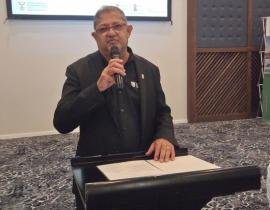
Deputy Minister Narend Singh recently addressed South African authorities, including prosecutors, the South African Police Service (SAPS), and the Coastal Marine Task Force (CMTF), at a training session in KwaZulu-Natal. This important gathering brought together key enforcement and legal personnel to strategize on more effective methods to combat environmental crimes. Singh emphasized that effective environmental enforcement is measured by successful prosecutions, appropriate sentencing, and the ability to protect resources for present and future generations. The Deputy Minister showed the critical role of each component within the justice system, stating, "Coordinated intelligence, lawful and careful investigation, properly preserved evidence, sound charge sheets, informed prosecutorial decisions, and consistent court follow-through must all function as integrated parts of a single, effective system." He further articulated the broader benefit of strong enforcement, adding, "Effective enforcement protects the space for these lawful participants to succeed." The training session in KwaZulu-Natal served as a key platform for these discussions, noting the government's commitment to preserving its natural heritage.
Urgent Need for Coordinated Enforcement
Protecting South Africa’s marine, coastal, and natural resources necessitates smooth, well-coordinated synergy across the entire enforcement and prosecutorial chain, according to officials. These activities, which include illegal, unreported, and unregulated fishing, place unsustainable pressure on marine resources, undermine lawful fishers, endanger enforcement officers and the public, and erode respect for the law. The widespread nature of these illicit operations demands a unified and strategic response from all relevant agencies. The government has demonstrated its commitment to supporting legal fishing activities by allocating long-term fishing rights to 172 cooperatives, representing approximately 10,000 fishers, through its Small-Scale Fisheries Policy. This initiative aims to empower local communities while ensuring sustainable practices, making the fight against illegal fishing even more critical to protect these legitimate livelihoods.
Beyond marine offenses, illegal development in sensitive coastal areas, such as Umgababa, forestry transgressions, and other environmental offenses, also require an integrated response from authorities. The two-day training session for South African authorities was specifically designed to enhance this coordinated effort by covering a full range of key areas. These areas included the Marine Living Resources Act, focusing on its application and enforcement; strategies to combat illegal, unreported, and unregulated fishing; the Integrated Coastal Management Act, which governs coastal zone protection; controls on off-road vehicles in sensitive ecosystems; municipal development enforcement to prevent unauthorized construction; forestry legislation aimed at preventing illegal logging; mining and water-use compliance to ensure sustainable resource extraction; biodiversity offenses that threaten unique species and habitats; and the effective management and protection of Marine Protected Areas. This broad curriculum reflects the multifaceted nature of environmental crime and the need for a holistic enforcement approach.
Challenges and Current Operations
Complex cases involving undocumented foreign nationals add layers of difficulty to enforcement efforts, requiring careful navigation of legal and diplomatic protocols. There are persistent reports of the illegal sale of crayfish, also known as East Coast rock lobster, occurring along the N2 highway near Hibberdene. This specific issue notes the ongoing challenge of illegal trade routes and the need for increased vigilance in key areas. The illicit trade not only depletes marine stocks but also often operates outside regulatory frameworks, posing risks to consumers and legitimate businesses.
In the period from April to June 2026, joint operations by various law enforcement agencies resulted in the opening of six case dockets under the Marine Living Resources Act. These operations led to nine arrests during the same timeframe, demonstrating tangible progress in apprehending those involved in marine resource offenses. Authorities also issued 22 admission-of-guilt fines, totaling R42 000, for various offenses, indicating a range of infractions being addressed.
Significant confiscations made between April and June 2026 further show the scale of illegal activities and the effectiveness of enforcement efforts. These included 352 linefish, which were valued at an estimated R176 000, representing a substantial loss to illegal traders. Additionally, East Coast rock lobster worth R31 500 was confiscated, directly addressing the persistent illegal trade in this valuable species. Law enforcement also seized 47 illegal gillnets, with an estimated value of R21 150. These confiscations are key, as gillnetting activities continue to devastate estuaries, causing extensive damage to marine ecosystems and non-target species. The ongoing efforts to intercept and confiscate illegal gear and catches are vital steps in mitigating the environmental impact of these unlawful practices.
Minister's Vision for Success
Every purchase of unlawfully harvested marine resources contributes directly to the depletion of a national asset, according to officials, perpetuating a cycle that undermines conservation efforts and legal livelihoods. The Deputy Minister, Narend Singh, has consistently emphasized that effective environmental enforcement is not merely about making arrests but is ultimately measured by successful prosecutions, appropriate sentencing, and the overarching ability to protect resources for present and future generations. Singh reiterated his foundational belief that "coordinated intelligence, lawful and careful investigation, properly preserved evidence, sound charge sheets, informed prosecutorial decisions, and consistent court follow-through must all function as integrated parts of a single, effective system." He further articulated that the ultimate goal of such strong enforcement is to create a secure and fair environment, adding that "Effective enforcement protects the space for these lawful participants to succeed." Protecting South Africa’s marine, coastal, and natural resources necessitates smooth, well-coordinated synergy across the entire enforcement and prosecutorial chain, ensuring that the nation's natural wealth is preserved for generations to come.