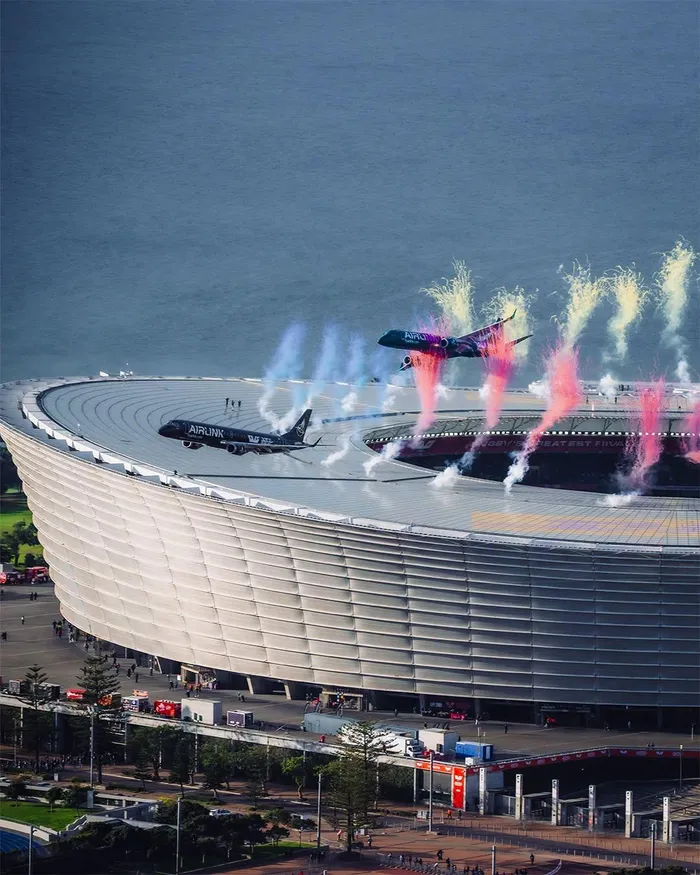
Airlink performed a formation flyby over Cape Town’s DHL Stadium on Saturday, which subsequently drew concerns on social media and online forums regarding the aircraft's low altitude. The South African airline addressed these apprehensions, stating that the maneuver was executed within approved guidelines. "Airlink says its formation flyby over Cape Town’s DHL Stadium was conducted within safety parameters approved by the aviation authorities, after concerns were raised online about how low the aircraft appeared to fly," the company affirmed. The event, a formation flyby over Cape Town’s DHL Stadium on Saturday, was organized to generate excitement for an upcoming major sporting event.
Flight Details and Analysis
Two Airlink Embraer aircraft, a green ZS-YAE E190 and a black ZS-YDE E195, performed the formation flyby. The flight involved flying at low altitude, maintaining a speed of approximately 150 knots. This specific speed and altitude profile were part of the planned aerial display. Analysis by FlightRadar24, based on the aircraft's ADS-B altitude data, indicated the planes passed less than 50 feet above the stadium's highest point. This finding from FlightRadar24 provided a concrete data point for the public discussion. The lowest recorded ADS-B altitude during the maneuver was 50 feet above mean sea level at standard pressure. FlightRadar24 further estimated the aircraft's altitude at 205 to 210 feet above mean sea level, after correcting for local atmospheric pressure. The DHL Stadium, situated near sea level, has a structure that reaches about 164 feet in height. Based on these calculations, FlightRadar24 determined the aircraft's clearance over the stadium was between 41 and 46 feet. These precise measurements contributed to the ongoing debate about the safety margins of the flyby. Airlink maintained that its "formation flyby over Cape Town’s DHL Stadium was conducted within safety parameters approved by the aviation authorities, after concerns were raised online about how low the aircraft appeared to fly." The airline's consistent statement aimed to reassure the public despite the detailed altitude analysis.
Official Assurances and Rehearsals
Airlink stated that flight data recorded by both aircraft involved in the maneuver confirmed the flyby was conducted within the safety altitude and speed limits approved and rehearsed by the South African Civil Aviation Authority (SACAA). This adherence to pre-approved parameters was a key point in Airlink's defense. The airline reiterated its position, saying, "Airlink says its formation flyby over Cape Town’s DHL Stadium was conducted within safety parameters approved by the aviation authorities, after concerns were raised online about how low the aircraft appeared to fly." The South African Civil Aviation Authority (SACAA) and Air Traffic Navigation Services provided guidance, approval, and support for the flyby, indicating a collaborative effort in planning the aerial display. Airlink's assertion showed the coordination with these regulatory bodies prior to the event, suggesting that all necessary precautions and authorizations were in place. The involvement of SACAA and Air Traffic Navigation Services implies a rigorous process was followed for the approval and execution of such a low-altitude maneuver.
Public Reaction and Context
The flyby formed part of the build-up to the Rugby’s Greatest Rivalry Series, featuring the Springboks and New Zealand’s All Blacks. This staging was intended to heighten public anticipation for the highly competitive matches between the two national rugby teams. The event aimed to generate public excitement ahead of the highly anticipated matches between the two national rugby teams. Airlink conducted the aerial display to mark the occasion, drawing both admiration and scrutiny for the aircraft's altitude. Concerns were raised on social media and online forums about the low altitude of the aircraft, sparking widespread discussion. The airline's actions, while intended to be a spectacle, prompted significant discussion across social media platforms and online forums regarding aviation safety protocols. Public response varied, with some observers expressing thrill at the low pass, while others voiced concerns over potential risks associated with the maneuver. Airlink's subsequent defense of its operations noted the contrasting perspectives on the event, setting the stage for an official review of the flyby's execution and adherence to regulatory standards. The debate showed the balance between creating a memorable public spectacle and upholding strict aviation safety regulations.