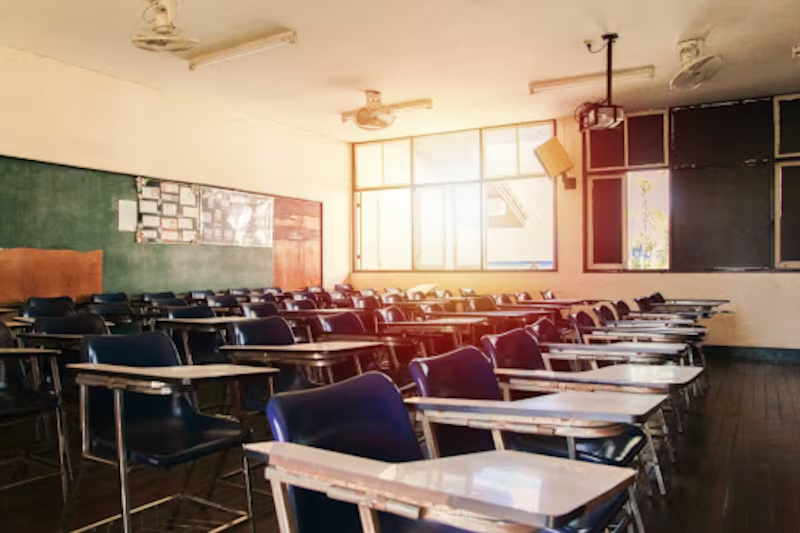
South African children and nearly half of the nation's teachers are actively incorporating artificial intelligence into schoolwork, teaching, and learning activities, often without established safeguards, official guidelines, or formal training. This widespread adoption comes as the Department of Basic Education works to develop formal structures and guidance for responsible AI use in education. Despite the absence of full frameworks, educators and students across South Africa are already experimenting with AI tools in their daily academic routines. The immediate integration of AI notes a gap between technological uptake and the implementation of official oversight. This rapid integration of AI into educational practices, largely unsupervised, shows a critical juncture for the South African schooling system. The Department of Basic Education's ongoing efforts to formulate full structures and guidance for responsible AI use are therefore timely and essential. However, the current reality indicates that teachers and learners are not waiting for official directives, actively exploring and utilising these powerful new tools.
Existing Educational Challenges
Artificial intelligence is integrating into a South African education system already facing significant challenges, including poor literacy outcomes, widespread language barriers, and high rates of learner dropout. The existing workforce of teachers also experiences considerable pressure. South African education is frequently described as comprising two distinct systems: a smaller, well-resourced sector with strong performance, and a much larger system serving learners with fewer resources and weaker educational results. Many schools currently lack reliable internet connectivity, essential digital devices, and the infrastructure necessary to support digital learning initiatives. The pace of AI development is exceeding that of traditional policy-making processes, creating a gap in official guidance for its educational integration. The introduction of AI into this complex environment adds another layer of consideration for policymakers and educators alike. The inherent disparities within the educational landscape mean that the benefits and risks of AI will likely be unevenly distributed, potentially exacerbating existing inequalities if not managed carefully. The challenge is not merely about integrating new technology, but doing so in a way that addresses, rather than compounds, long-standing systemic issues.
Potential Benefits and Current Use
Teachers in the UK who use AI chatbots for lesson planning have reported a 31% reduction in planning time without compromising quality. In the US, educators indicate saving an average of 5.9 hours weekly on tasks such as lesson planning, grading, providing feedback, and creating worksheets and rubrics. This time saving is equivalent to approximately six working weeks over a school year. Such efficiencies highlight the transformative potential of AI in alleviating the workload burden on teachers, allowing them to dedicate more time to direct student interaction and pedagogical development.
Better-resourced schools in South Africa are currently experimenting with artificial intelligence for various applications. These include enhancing lesson planning, boosting teacher productivity, facilitating personalised learning experiences, and aiding research activities. The integration of AI tools in these settings points to the potential for broader adoption. Beyond current applications, AI has the capacity to support several critical areas within education. It could facilitate personalised learning approaches tailored to individual student needs, adapting content and pace to optimise comprehension and engagement. Additionally, AI offers tools for assisting students with special educational needs, providing more targeted and adaptive support that can cater to diverse learning styles and requirements. The technology also presents opportunities for improving multilingual instruction, helping to bridge language barriers in diverse classrooms through real-time translation and language learning tools. AI can deliver real-time feedback to students, allowing for immediate adjustments and improvements in their learning process, a feature that can significantly accelerate skill acquisition and understanding. These applications demonstrate AI's potential to not only streamline administrative tasks but also fundamentally enhance the quality and accessibility of education.
Risks and Safeguarding Concerns
Without deliberate intervention, artificial intelligence is likely to benefit already advantaged learners first, potentially widening existing educational disparities. This risk is particularly acute in a country like South Africa, where educational outcomes are already stratified. Child safety remains one of the least developed parts of the AI-in-education debate, according to Shirley Eadie. Eadie stated, "Child safety remains one of the least developed parts of the AI-in-education debate." This concern is compounded by the design of some AI chatbots, which are engineered to be agreeable, a trait known as sycophancy. This characteristic can exacerbate issues by not challenging users sufficiently, potentially hindering critical thinking development. For many young people, AI risks becoming what the Center for Universal Education calls a “cognitive surrogate,” meaning it performs the work of thinking rather than strengthening a learner's own cognitive processes. The agreeable nature of these AI tools, while seemingly helpful, can inadvertently discourage independent thought and problem-solving, leading to a reliance on the AI for answers rather than using it as a tool for deeper exploration. The absence of full guidelines and training further amplifies these risks, as educators may not be equipped to identify or mitigate these subtle yet significant challenges to student development. Ensuring that AI serves as an enhancer of cognitive abilities, rather than a replacement, is a key safeguarding consideration that demands immediate attention.